



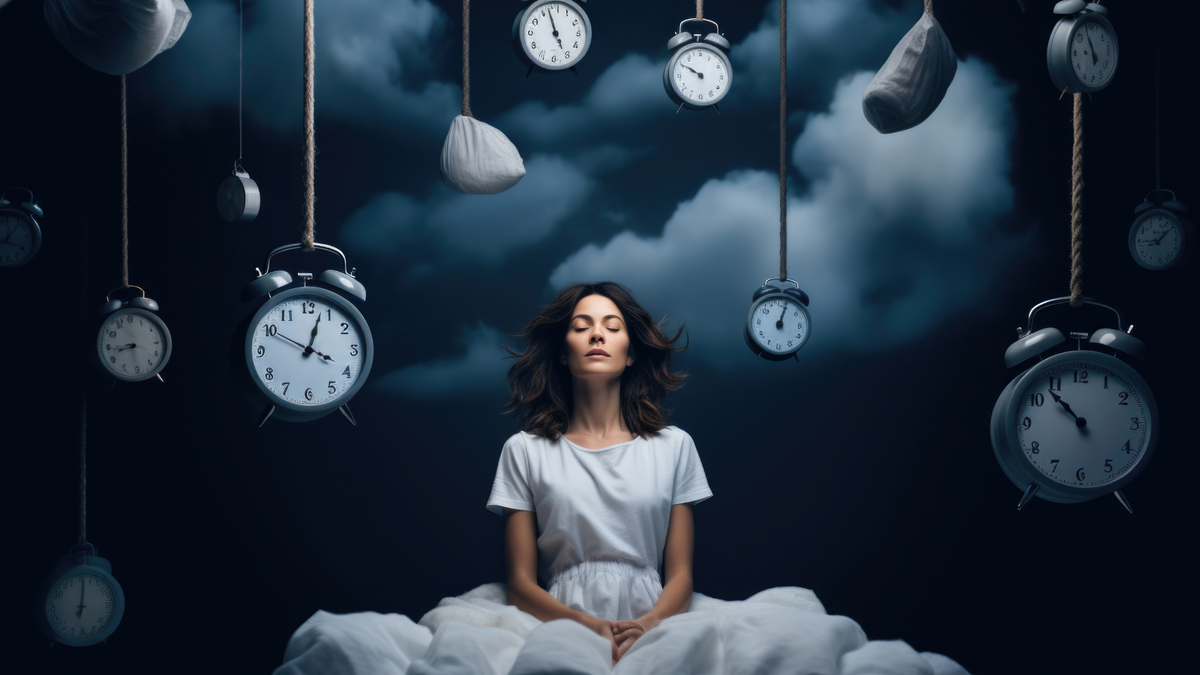
For people who sleep well, sleep is almost invisible.
You get tired.
You go to bed.
Then morning happens.
For people with chronic insomnia, sleep becomes the main character.
It is 11:48 p.m. and your body is exhausted while your brain apparently has plans.
It is waking up at 2:17 a.m. and immediately wondering how many hours remain before the alarm.
It is the strange dread that can eventually appear as bedtime approaches because you already know how the night might go.
People who have lived with insomnia for years are rarely beginners.
They have tried routines.
Supplements.
Prescriptions.
Meditation.
Magnesium.
No screens.
More screens because lying there doing nothing became unbearable.
Eventually, a reasonable question comes up:
Can THC actually help you sleep, and if it does, are the trade-offs worth it?
The answer is more nuanced than either side of the cannabis debate usually admits.
Cannabinoid products containing THC have improved insomnia symptoms and sleep quality in several randomized trials, and a recent meta-analysis found meaningful overall improvements across multiple sleep measures. But THC is not a perfect sleep aid. Dose, tolerance, sleep architecture, withdrawal, and long-term use all matter.
For someone barely sleeping, that does not make THC useless.
It makes the decision more interesting.
Quick Answer: Does THC Help You Sleep?
For some people, yes.
Research involving THC-containing cannabinoid formulations has found improvements in areas such as:
- Insomnia severity
- Perceived sleep quality
- Total sleep time
- Sleep efficiency
- Time spent awake during the night
- Time needed to fall asleep
A 2026 meta-analysis of 10 randomized controlled trials involving 2,134 participants found that cannabinoid treatments improved insomnia severity and overall sleep quality compared with control treatments.
Across those studies, total sleep time increased by about 34 minutes on average, while sleep onset improved by about 12 minutes.
That is meaningful.
But there are important limitations.
The studies used different combinations of:
- THC
- CBD
- CBN
- Delivery methods
- Doses
Most were relatively short.
And objective sleep measurements do not always agree with how much better people say they slept.
So the best current answer is:
Cannabinoids can improve sleep for some people, but we still do not know the ideal THC dose, formulation, or long-term strategy for chronic insomnia.
Chronic Insomnia Is Different From Having a Bad Night
Everyone sleeps badly sometimes.
Chronic insomnia is something else.
It can involve persistent difficulty:
- Falling asleep
- Staying asleep
- Returning to sleep
- Waking earlier than intended
along with daytime consequences such as:
- Fatigue
- Difficulty concentrating
- Irritability
- Reduced performance
- Mood changes
And sometimes the worst part is psychological.
After enough bad nights, you stop trusting sleep.
The bed itself starts to feel like a test.
That matters because the harder you try to force sleep, the more awake you can become.
The First-Line Treatment for Chronic Insomnia Is Not a Supplement
This deserves to be near the top.
For chronic insomnia, one of the best-supported treatments available is cognitive behavioral therapy for insomnia, usually called CBT-I.
The American Academy of Sleep Medicine strongly recommends CBT-I for chronic insomnia in adults.
CBT-I is more involved than ordinary sleep-hygiene advice.
It can include:
- Changing behaviors that reinforce insomnia
- Stimulus control
- Adjusting time spent awake in bed
- Restructuring anxious thoughts about sleep
- Building a more reliable sleep schedule
This matters because someone with years of insomnia does not necessarily need another article saying:
Try turning your phone off earlier.
Sometimes the problem has become a learned cycle involving sleep itself.
THC may affect symptoms.
CBT-I tries to change the system underneath them.
Those are different tools.
What Does THC Actually Do for Sleep?
THC, or Delta-9 tetrahydrocannabinol, interacts strongly with CB1 cannabinoid receptors throughout the brain and nervous system.
That can influence:
- Alertness
- Perception
- Stress response
- Pain perception
- Mood
- Sleepiness
For some people, the practical experience is straightforward.
The internal conversation gets quieter.
Physical discomfort becomes less noticeable.
The transition from:
Doing
to:
Not doing
becomes easier.
That subjective experience is one reason cannabis has become so widely used for sleep.
And unlike years ago, we now have randomized trials showing that the benefit is not purely anecdotal.
One of the Best Insomnia Trials Found Meaningful Improvement
A randomized, double-blind, placebo-controlled crossover trial studied adults with chronic insomnia.
Participants received a nighttime cannabinoid formulation containing THC, CBN, and CBD for two weeks.
Compared with placebo, participants reported:
- Lower insomnia severity
- Falling asleep faster
- More total sleep
- Better sleep quality
- Feeling more rested after waking
Objective activity measurements also showed:
- Less time awake after falling asleep
- More total sleep
- Improved sleep efficiency
The trial was small, with only 23 participants completing it.
So it should not be treated as the final answer.
But the improvement was substantial enough to make cannabinoid sleep research worth taking seriously.
Newer Low-Dose Research Is Interesting Too
A 2025 randomized placebo-controlled pilot trial tested an oral formulation containing:
- 3 mg THC
- 6 mg CBN
- 10 mg CBD
in adults with milder insomnia symptoms.
The study lasted 10 nights.
Compared with placebo, the cannabinoid formulation improved measures of:
- Sleep quality
- Sleep efficiency
- Insomnia symptoms
- Health-related quality of life
The study included only 20 participants, so larger trials are needed.
Still, this is especially interesting because the THC amount was relatively low.
It reinforces an idea that makes intuitive sense for nighttime cannabis:
You may not need a large THC dose to explore a sleep effect.
Then Why Do Some Sleep Studies Show the Opposite?
Because sleep research gets complicated very quickly.
People can report:
I slept much better.
while instruments measuring brain activity tell a different story.
A 2025 randomized laboratory study gave adults with insomnia a single oral dose containing:
10 mg THC plus 200 mg CBD.
Compared with placebo, the cannabinoid treatment actually reduced objectively measured total sleep time by about 25 minutes.
It also reduced REM sleep.
That sounds like it contradicts the positive studies.
In a way, it does.
And that is exactly why simplistic conclusions do not work yet.
Different cannabinoid ratios.
Different doses.
Different formulations.
Different treatment durations.
Different people.
Different measurements.
Sleep is not one number.
Does THC Reduce REM Sleep?
This is one of the most repeated cannabis sleep claims:
THC destroys REM sleep.
The current evidence does not support such a simple statement.
A 2025 systematic review and meta-analysis looked specifically at cannabis and objectively measured sleep architecture.
Researchers found that cannabis did not consistently alter:
- Total sleep time
- Sleep latency
- Sleep efficiency
- Wake time
- Sleep stages
Earlier studies had suggested substantial REM suppression.
But many of those studies were:
- Small
- Older
- Conducted with relatively high THC doses
More recent studies using lower doses have produced mixed results.
So does THC affect REM?
It can.
Can we say every nighttime THC dose dramatically suppresses REM?
No.
That claim has gotten ahead of the evidence.
Read the 2025 sleep architecture review
Why Do Dreams Sometimes Get Wild When You Stop THC?
This part of the story is more consistent.
Sleep disturbance is a well-recognized feature of cannabis withdrawal.
People who regularly use cannabis and then stop can experience:
- Difficulty falling asleep
- Reduced total sleep
- Fragmented sleep
- More vivid dreams
- REM rebound
REM rebound means REM sleep increases after previously being suppressed or altered.
This probably explains the classic experience:
I stopped weed and suddenly my dreams became insane.
It does not happen identically to everyone.
But the relationship between cannabis withdrawal and disrupted sleep appears considerably more consistent than many claims about what cannabis does to normal sleep architecture while you are taking it.
This Is the Real Long-Term Trade-Off
THC can help someone sleep.
Then the body adapts.
The same dose becomes less noticeable.
The dose gradually increases.
Eventually, skipping THC produces a terrible night of sleep.
That can create an uncomfortable loop:
THC helps sleep.
Then:
Not taking THC hurts sleep.
So you become increasingly convinced you cannot sleep without it.
That does not happen to everyone.
But it is one of the most important reasons to keep THC doses intentional rather than endlessly escalating.
If 2.5 mg works, there is no prize for moving to 5 mg.
If 5 mg works, there is no reason to automatically move to 10 mg.
More THC is not the goal.
Sleep is.
The Question Most THC Sleep Articles Ask Wrong
People often ask:
Is THC perfect for sleep architecture?
For someone sleeping eight hours comfortably already, that can be an interesting academic question.
For someone sleeping four broken hours every night, there is another question:
Does THC help enough to make life noticeably better?
That does not mean the trade-offs should be ignored.
It means the comparison should be realistic.
Chronic insomnia itself has consequences.
Poor sleep affects:
- Attention
- Mood
- Memory
- Reaction time
- Quality of life
- Physical and mental functioning
So the choice is rarely:
Perfect natural sleep
versus:
THC-assisted sleep.
For someone with severe insomnia, the real-world comparison might be:
A poor night without THC
versus:
a noticeably better night with a low THC dose.
That is a much more honest decision.
And it is one that ultimately depends on the individual, their health, their response, and what other treatments they have tried.
Falling Asleep Is Not the Same as Sleeping Well
This distinction gets overlooked constantly.
A substance can make you sleepy without necessarily improving the entire night.
Good sleep includes:
- Falling asleep reasonably efficiently
- Staying asleep
- Moving through normal sleep stages
- Getting enough total sleep
- Waking feeling restored
THC may affect some of those dimensions differently.
Someone might fall asleep much more easily but still wake several times.
Another person might sleep longer but wake groggy.
Someone else might report an excellent night's sleep even though laboratory measurements barely changed.
The outcome that matters most is not simply:
Did this make me sleepy?
It is:
Did my sleep and next day actually improve?
What About Next-Day Grogginess?
It can happen.
Especially when:
- The THC dose is too high
- The edible is taken very late
- The person is THC-sensitive
- Other sedating substances are involved
But next-day impairment is not guaranteed.
A 2024 randomized pilot study gave adults with insomnia 10 mg oral THC plus 200 mg CBD at night.
At least nine hours later, researchers found no meaningful impairment compared with placebo on 27 of 28 cognitive, psychomotor, and simulated-driving measures.
There was a small increase in self-reported sedation.
That study included only 20 participants and used an unusual high-CBD formulation, so it should not be generalized to every gummy.
Still, it is useful evidence against the assumption that evening THC automatically means severe impairment the following morning.
The practical rule remains simpler:
If you still feel impaired, do not drive.
THC Dose May Matter More Than Almost Anything Else
This is where nighttime THC can go wrong quickly.
You want to sleep better.
So you assume:
More THC equals more sleep.
Not necessarily.
A dose that helps you unwind may become a dose that leaves you:
- Uncomfortably high
- Dizzy
- Anxious
- Mentally stimulated
- Groggy the following morning
For someone new to THC, starting low makes far more sense than chasing sedation.
CBDX Lights Out Sugar-Free Sleep Gummies currently offer three THC strengths paired with 10 mg CBN:
- Low Dose: 2.5 mg Delta-9 THC plus 10 mg CBN
- Mid Dose: 5 mg Delta-9 THC plus 10 mg CBN
- High Dose: 10 mg Delta-9 THC plus 10 mg CBN
The 2.5 mg version is melatonin-free.
That makes the low-dose version particularly interesting for someone who wants to explore a small amount of nighttime THC rather than starting with a conventional 10 mg edible.
The product has not been clinically tested as a treatment for insomnia.
It simply gives consumers the ability to choose a genuinely lower THC dose.
For a deeper dose comparison, read our THC Gummy Dosage Guide.
What About CBN?
CBN has become known as the sleep cannabinoid.
The research is still young.
One randomized trial involving 293 adults found that 20 mg of CBN reduced nighttime awakenings and overall sleep disturbance compared with placebo.
Interestingly, it did not significantly help people fall asleep faster.
That suggests CBN may eventually prove more interesting for sleep continuity than simply sedation.
CBDX pairs 10 mg CBN with every current Lights Out THC strength.
For the deeper story, read CBN Gummies for Sleep: What the Research Actually Says.
If you prefer to avoid THC completely, CBDX also offers THC-Free Sleep Gummies, including Lunar Drift and Lights Out Zero.
Before Adding THC, Fix the Obvious Sleep Saboteurs
THC should not have to compensate for a sleep environment working against you.
You do not need a perfect wellness routine.
But a few fundamentals deserve attention.
Get Bright Light Earlier in the Day
Your circadian system uses light as one of its strongest timing signals.
Bright outdoor light after waking helps reinforce the distinction between:
daytime
and:
nighttime.
You do not need to obsess over an exact twenty-minute rule.
Just make daylight part of the beginning of your day whenever possible.
Watch Late Caffeine
Caffeine lasts longer than many people realize.
If you are struggling to fall asleep, experiment with moving your last caffeinated drink earlier.
Do not assume:
Coffee doesn't affect me because I can fall asleep after drinking it.
Falling asleep is only one part of sleep quality.
Use Your Body During the Day
Regular physical activity is associated with better sleep.
Walking is enough to count.
You do not need a punishing evening workout.
The goal is simply not spending sixteen waking hours almost completely sedentary and expecting the body to produce perfect sleep pressure on command.
Keep the Wake Time More Consistent
People obsess over bedtime.
Your wake time is often the more powerful anchor.
Sleeping until noon after a terrible night can feel necessary.
But constantly changing the schedule can make the next night's timing harder.
Consistency gives the circadian system something predictable to work with.
What About Magnesium?
Magnesium is worth discussing without turning it into a miracle mineral.
Magnesium is essential for normal nerve and muscle function.
Some studies suggest supplementation may improve sleep in particular populations, especially when intake or magnesium status is inadequate.
But the evidence for magnesium as a universal insomnia treatment is still limited.
If you suspect a deficiency or have a medical reason to consider supplementation, discuss the appropriate form and dose with a healthcare professional.
It may help.
It does not replace investigating chronic insomnia.
When "Sleep Hygiene" Is Not Enough
This is important.
If you have been dealing with insomnia for years, being told to:
- Buy blackout curtains
- Stop looking at your phone
- Drink chamomile tea
- Take a warm bath
can become almost insulting.
Those things can support good sleep.
They do not necessarily treat chronic insomnia disorder.
If the basics are already reasonable and you still cannot sleep, look deeper.
Possibilities include:
- Chronic insomnia disorder
- Sleep apnea
- Restless legs syndrome
- Depression
- Anxiety
- Pain
- Menopause
- Medication effects
- Circadian rhythm disorders
- Alcohol
- Other medical conditions
This is where CBT-I, sleep medicine, and a proper evaluation can matter more than another supplement.
Sleep Anxiety Is Real
One of the cruelest parts of insomnia is that eventually you can become anxious about not sleeping.
You check the clock.
Six hours left.
Again.
Five hours and twelve minutes.
Then:
If I fall asleep right now, I can still get four hours and forty-seven minutes.
The arithmetic itself keeps you awake.
Some people describe THC as useful not because it "knocks them out," but because the mental grip around bedtime loosens.
That experience has not been neatly quantified in clinical trials.
But it is psychologically plausible and commonly reported.
And sometimes reducing the struggle around sleep matters almost as much as reducing the minutes it takes to fall asleep.
When THC for Sleep Probably Makes Less Sense
THC is not a good fit for everyone.
Be especially cautious if you:
- Consistently become anxious or paranoid from THC
- Have a history of significant THC sensitivity
- Have a personal or strong family history of psychosis
- Are pregnant or breastfeeding
- Need to drive or perform safety-sensitive work soon after use
- Take medications that may interact with cannabinoids
- Frequently combine THC with alcohol or sedating medications
- Find yourself continuously increasing the dose
- Feel unable to sleep at all when you skip THC
That last one deserves attention.
If a sleep tool has gradually become something your sleep system cannot function without, it may be time to reassess the pattern.
Can THC Be Used Every Night?
There is no good universal answer.
Most randomized insomnia trials involving cannabinoids have lasted days or weeks, not years.
That means short-term evidence is much better than long-term evidence.
Nightly THC may work well for some people.
Regular use can also increase:
- Tolerance
- Dependence risk
- Withdrawal-related sleep problems
So if you use THC regularly for sleep, the questions worth asking periodically are:
Is the same dose still working?
Has the dose been creeping upward?
Do I sleep better overall?
How do I feel the next day?
What happens when I don't take it?
Those answers tell you more than simply saying:
I've used it every night and I'm fine.
Does THC Sleep Become "Fake Sleep"?
No.
That phrase oversimplifies the science.
Sleep after THC is still sleep.
The legitimate question is whether THC changes sleep architecture and whether those changes matter clinically.
Right now, the evidence is mixed.
Some studies show changes in REM and other stages.
Others do not.
And interestingly, improvements people report in sleep quality are sometimes larger than the changes researchers can measure objectively.
That gap between:
How sleep looks in a laboratory
and:
How restored someone actually feels
is one of the most interesting unanswered questions in cannabinoid sleep research.
THC vs Doing Nothing
This section is worth keeping because it reflects how people actually make decisions.
If someone is sleeping beautifully without THC, there is no obvious reason to add an intoxicating cannabinoid simply because it might make them sleep differently.
But someone who has struggled with chronic insomnia for years begins from another place entirely.
For that person, the calculation may include:
- Current sleep quality
- Daytime functioning
- Treatments already tried
- THC response
- Dose
- Side effects
- Tolerance
- Other health conditions
- Personal preferences
A theoretical downside needs to be considered.
So does the downside of continuing to sleep terribly.
That does not automatically make THC the answer.
It means doing nothing is not always the neutral option people assume it is.
A Better Way to Think About THC for Sleep
Instead of asking:
Is THC good or bad for sleep?
ask:
What happens to my sleep when I use the smallest effective dose?
Then look at the whole outcome.
Did you:
- Fall asleep more easily?
- Wake less often?
- Sleep longer?
- Feel more rested?
- Wake groggy?
- Need more THC over time?
- Become anxious when you skipped it?
That gives you a much better answer than ideology ever will.
Frequently Asked Questions About THC and Sleep
Does THC help insomnia?
THC-containing cannabinoid formulations have improved insomnia symptoms in several randomized controlled trials.
However, studies remain relatively short and use different cannabinoid combinations and doses.
THC gummies are not FDA-approved treatments for insomnia.
Does THC help you fall asleep faster?
Some trials have found modest improvements in sleep onset.
A recent meta-analysis of cannabinoid trials found an average reduction in sleep-onset latency of about 12 minutes.
Individual responses vary considerably.
Does THC reduce REM sleep?
Sometimes, but not consistently.
A 2025 systematic review found that newer evidence does not support a universal claim that cannabis consistently suppresses REM sleep.
Higher doses may have different effects from lower doses.
Why do I have vivid dreams when I stop THC?
Cannabis withdrawal is commonly associated with sleep disturbance and REM rebound, which can contribute to unusually vivid dreams.
Can you build a tolerance to THC for sleep?
Yes.
Regular THC exposure can produce tolerance, meaning the same dose may feel less effective over time.
Will THC make me groggy the next morning?
It can.
Dose, timing, individual sensitivity, other medications, and the specific formulation all matter.
What is a good THC dose for sleep?
There is no universally established clinical THC dose for insomnia.
For someone new or sensitive to THC, a lower-dose approach is more conservative than beginning with a strong edible.
CBDX Lights Out currently begins at 2.5 mg Delta-9 THC plus 10 mg CBN.
Is CBN better than THC for sleep?
There is not enough research to declare one universally better.
CBN has emerging human evidence around nighttime awakenings, while THC-containing formulations have more direct research involving insomnia.
Is CBD good for sleep?
CBD's relationship with sleep is complicated and dose-dependent.
CBD alone should not automatically be treated as a sedative.
Can I replace prescription sleeping pills with THC?
Do not abruptly stop or replace a prescribed sleep medication without speaking with the clinician who prescribed it.
Some sleep and anxiety medications can cause significant withdrawal or rebound symptoms when stopped suddenly.
The Honest Verdict: Better Beats Perfect, but Pay Attention to the Trade-Off
THC is not a miracle sleep switch.
It does not consistently improve every aspect of sleep.
It can change sleep architecture.
Tolerance can develop.
Regular users can sleep poorly when they stop.
Some people wake groggy.
Some people become anxious.
And we still need much better long-term research.
But that is not the whole story.
Randomized human trials increasingly show that cannabinoid formulations can improve insomnia symptoms.
People report sleeping longer.
Falling asleep more easily.
Waking less.
Feeling more rested.
And a recent analysis of multiple trials suggests the overall sleep benefit is real enough to keep studying seriously.
So perhaps the question was never:
Is THC perfect for sleep?
Almost nothing is.
The more useful question is:
Does it improve sleep enough, at a low enough dose, with few enough trade-offs, to make your life better?
For some people, the answer will be no.
For others, it may be yes.
That is where thoughtful use begins.
Not chasing the strongest gummy.
Not pretending THC has no downside.
And not dismissing something potentially useful because it does not produce laboratory-perfect sleep.
Sometimes better sleep really is better.
Just keep asking whether it is still better over time.
Explore Lights Out Sugar-Free Sleep Gummies, browse the full CBDX Sleep Collection, or read CBN Gummies for Sleep: What the Research Actually Says.
This article is for general educational purposes only and is not intended to diagnose, treat, cure, or prevent insomnia or any other medical condition. THC is intoxicating and may impair judgment and coordination. Do not drive or operate machinery while impaired. Do not stop or change prescription sleep medication without consulting your healthcare professional.
Last reviewed and updated: September 2026


