



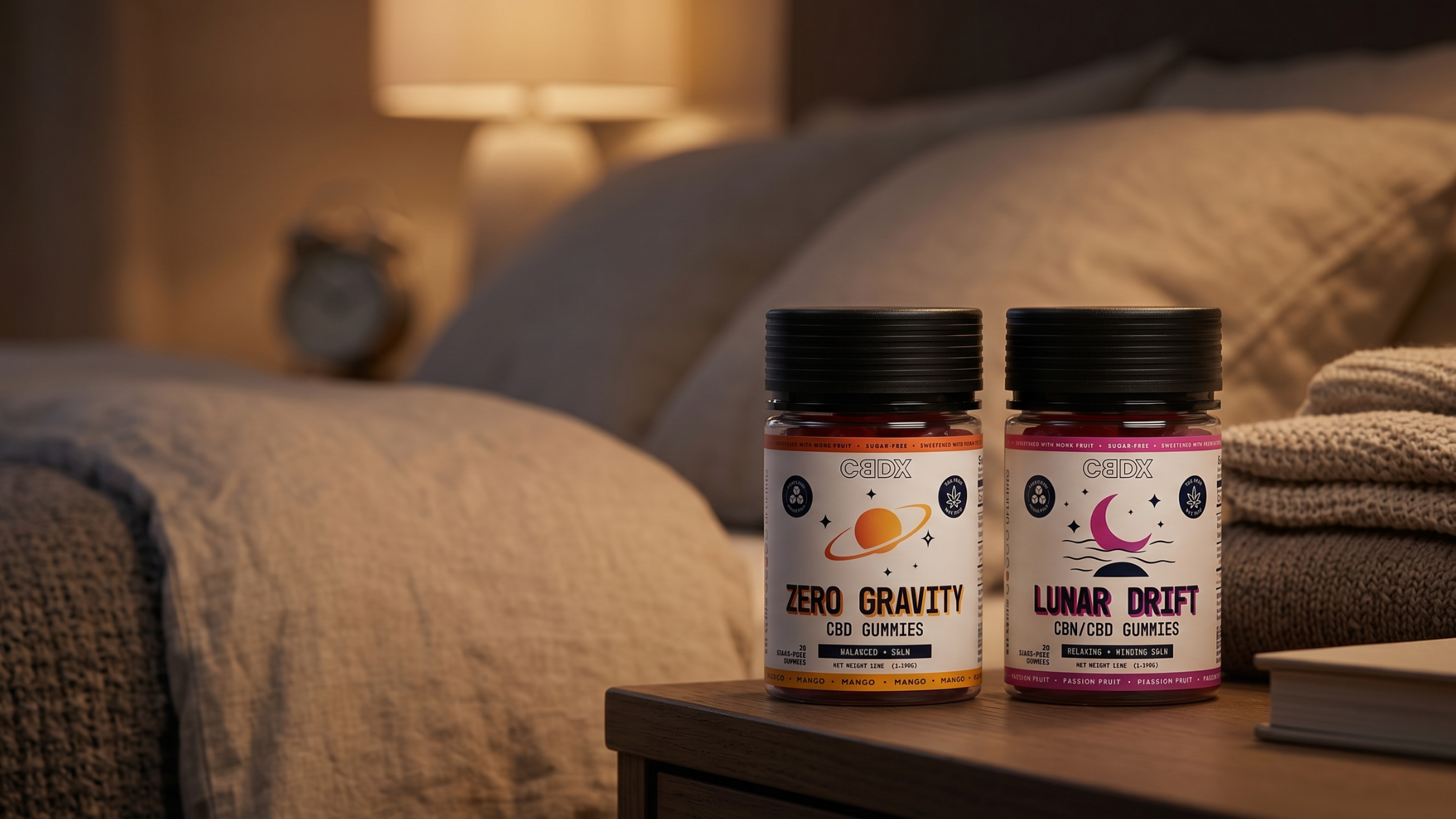
CBD and CBN show up together in a growing number of nighttime gummies.
The assumption is usually simple: if CBD is calming and CBN is associated with sleep, combining them should work even better.
The research tells a more interesting story.
CBD and CBN are two different non-THC cannabinoids that can be used together, but current human research has not shown that adding CBD makes CBN more effective for sleep. CBN itself has produced some encouraging results for nighttime awakenings and overall sleep disturbance, while evidence for CBD as a direct sleep aid remains mixed.
That doesn't mean the combination doesn't have a place.
It means we should understand what each cannabinoid actually brings to the table.
Key Takeaways
- CBD and CBN are different cannabinoids with different pharmacological profiles.
- Neither is used primarily for a THC-like intoxicating experience.
- A randomized trial found that 20 mg CBN reduced nighttime awakenings and overall sleep disturbancecompared with placebo.
- In that same study, adding CBD to CBN did not improve the sleep effects of CBN.
- CBD itself has shown mixed results for sleep. In one recent insomnia trial, 150 mg nightly performed similarly to placebo on most sleep outcomes.
- CBD + CBN can still make sense as a THC-free nighttime formulation, but it should not be marketed as proven cannabinoid synergy.
This article is for general informational purposes only and is not intended to diagnose, treat, cure, or prevent any disease.
What Is CBD?
CBD, or cannabidiol, is a cannabinoid found in cannabis and hemp that does not produce the characteristic high associated with THC.
CBD has become one of the most widely used cannabinoids and is found in everything from gummies and tinctures to prescription medication.
People commonly use consumer CBD products as part of relaxation, wellness, or nighttime routines.
But it's worth separating popularity from proof.
CBD has been researched extensively compared with many minor cannabinoids, yet evidence for common consumer uses such as stress and sleep varies significantly by dose, population, and study design.
The CDC also notes that CBD is not impairing in the same way THC is, although CBD products are not risk-free and can cause side effects or interact with medications.
What Is CBN?
CBN, or cannabinol, is a cannabinoid that has become especially popular in products designed for nighttime use.
For years, CBN was routinely called the “sleep cannabinoid” despite very little human evidence supporting that reputation.
That's finally beginning to change.
A randomized, double-blind, placebo-controlled trial studied 293 adults who rated their sleep as poor or very poor.
Participants receiving 20 mg CBN nightly experienced fewer nighttime awakenings and less overall sleep disturbance than those receiving placebo.
The study did not find a statistically significant improvement in its primary overall sleep-quality outcome, nor did CBN significantly improve sleep-onset latency or time awake after falling asleep.
So the evidence is promising.
It just isn't a blanket statement that “CBN makes you sleep.”
Does CBD + CBN Work Better Than CBN Alone?
Not according to the best controlled human study we currently have.
This is where the story gets interesting.
Researchers didn't just test CBN.
They compared:
- placebo
- 20 mg CBN
- 20 mg CBN + 10 mg CBD
- 20 mg CBN + 20 mg CBD
- 20 mg CBN + 100 mg CBD
The result?
Adding CBD did not positively enhance CBN's sleep effects.
In other words, the popular assumption that CBD + CBN must be better for sleep than CBN alone wasn't supported by that trial.
That's useful information.
Cannabinoids can interact, but combining two compounds doesn't automatically create synergy.
So Why Combine CBD and CBN?
CBD + CBN can still make sense as a THC-free cannabinoid profile for people who prefer using multiple non-intoxicating cannabinoids together.
That's different from claiming the pairing has been clinically proven superior.
Some people simply prefer the subjective experience of a blended formula.
Others may already use CBD and want to explore CBN without introducing THC.
And for someone who specifically wants a nighttime cannabinoid product without a traditional THC high, the pairing offers a straightforward alternative.
The important distinction is this:
Product preference and proven clinical superiority are not the same thing.
What Does CBD Actually Do for Sleep?
CBD's relationship with sleep is more complicated than its reputation suggests.
A randomized controlled trial involving adults with moderate-to-severe insomnia tested 150 mg of CBD nightly.
CBD performed similarly to placebo on most sleep outcomes, although researchers observed improvements in some measures of well-being.
Another randomized study comparing cannabinoid and melatonin formulations found that low-dose CBD formulations improved sleep ratings, but adding low doses of CBN or CBC did not significantly improve those effects.
So CBD may fit naturally into someone's nighttime routine.
But saying CBD simply “quiets the mind” or directly improves sleep for everyone goes beyond what the evidence currently establishes.
Does CBN Make You Sleepy?
CBN appears more promising for certain aspects of sleep than it did just a few years ago, but it should not be treated like a conventional sedative.
The strongest CBN trial found fewer nighttime awakenings and lower overall sleep disturbance.
Interestingly, researchers did not find increased daytime fatigue.
That makes the result particularly interesting.
The benefit wasn't simply:
Take CBN → become heavily sedated.
Instead, the signal appeared primarily around sleep continuity.
That's a much more precise way to discuss what CBN may do.
CBD + CBN vs. THC for Nighttime Use
CBD + CBN offers a fundamentally different cannabinoid experience from a THC-containing nighttime gummy.
THC is intoxicating.
CBD is not considered impairing in the same way. CBN is also generally used in non-THC formulations rather than for a traditional cannabis high.
For people who are sensitive to THC, don't enjoy feeling high, or simply prefer a THC-free nighttime routine, CBD + CBN can therefore be an appealing option.
That doesn't mean it is automatically “better” than THC.
It serves a different purpose.
CBD + CBN and the Entourage Effect
The entourage effect is the idea that cannabis compounds can influence one another when used together.
Cannabinoid interactions are real.
What we don't have is evidence that every multi-cannabinoid combination automatically produces a better result.
CBD + CBN is actually a useful example.
If the entourage-effect idea meant “two cannabinoids always work better than one,” we'd expect adding CBD to CBN to consistently improve sleep outcomes.
The controlled trial did not show that.
That's why cannabinoid formulation should be evaluated by the actual ingredients, doses, research, and user experience rather than simply counting how many cannabinoids appear on the label.
For a broader look at this topic, see our guide to Combining Cannabinoids for Better Effects.
Meet Lunar Drift: CBDX's CBD + CBN Formula
CBDX Lunar Drift CBN Gummies combine:
- 15 mg CBN
- 5 mg CBD
- No intentionally added THC
- Third-party lab testing
- A sugar-free monk-fruit option
The current formula is designed specifically as a simple nighttime cannabinoid gummy rather than an intoxicating THC product.
One important point about the research:
The clinical trial discussed above used 20 mg CBN with CBD doses ranging from 10 to 100 mg. Lunar Drift's 15 mg CBN + 5 mg CBD ratio has not itself been clinically tested in that study.
That's why we view the research as context for the cannabinoids, not proof of a specific product outcome.
When Should You Take CBD + CBN?
There is no scientifically established perfect time for every CBD + CBN gummy.
For a nighttime product, taking it early enough to observe how your body responds makes more sense than swallowing it the moment your head hits the pillow.
Oral cannabinoids need time to move through digestion and absorption.
If you're trying a CBD + CBN gummy for the first time, choose an evening when your schedule is clear and you can pay attention to how the formulation affects you.
Can You Take CBD and CBN Every Night?
Long-term research on regular CBN use remains limited.
The placebo-controlled CBN sleep study lasted seven nights.
That gives us useful short-term human data, but not years of evidence about nightly use.
CBD also has known potential for medication interactions, so anyone taking prescription medications or managing a medical condition should discuss regular cannabinoid use with an appropriate healthcare professional.
Frequently Asked Questions
Is CBD + CBN better for sleep than CBN alone?
Current evidence does not show that.
In a randomized trial, 20 mg CBN reduced nighttime awakenings and overall sleep disturbance, while adding CBD did not improve those effects.
Does CBN help you fall asleep faster?
The best controlled trial did not find a significant reduction in sleep-onset latency compared with placebo.
Its strongest findings involved fewer awakenings and lower overall sleep disturbance.
Will CBD and CBN get you high?
CBD does not produce a traditional THC high.
A CBD + CBN product without intoxicating THC is therefore very different from a delta-9 THC gummy. Always check the actual product's cannabinoid panel rather than assuming based only on the front label.
Is CBN stronger than CBD?
They're different cannabinoids, so “stronger” isn't particularly useful.
CBN currently has some interesting human evidence involving nighttime awakenings. CBD has been researched far more broadly but has produced mixed results specifically for sleep.
Is CBD + CBN proven to have an entourage effect?
No.
The cannabinoids can interact, but current evidence does not establish that CBD + CBN produces a clinically superior synergistic effect.
The Bottom Line
CBD and CBN make an interesting pair.
Just not for the reason most marketing suggests.
CBN now has early human evidence showing improvements in nighttime awakenings and overall sleep disturbance. CBD has a much larger research history, but its direct effects on sleep remain mixed. And so far, adding CBD has not been shown to make CBN work better for sleep.
That doesn't make CBD + CBN pointless.
It makes it a choice.
For people who want to explore a THC-free, multi-cannabinoid nighttime routine, the combination offers a different path from THC-based sleep formulas.
No exaggerated promises required.
Sometimes the science is interesting enough on its own.


