



When it comes to hemp-derived edibles and gummies, ratios matter. The balance between THC and other cannabinoids, including CBD, CBN, and CBG, can influence the experience. But choosing between a 1:1 and a 5:1 product can be confusing if you don't know what those numbers mean.
In this guide, we'll explain how THC ratios work, what common combinations mean, and how to read cannabinoid amounts when comparing products.
This article is for general educational purposes only and is not medical advice.
THC Ratios at a Glance
A cannabinoid ratio compares amounts, not potency. A 2:1 CBD:THC gummy contains twice as much CBD as THC, but you still need to read the milligrams of THC per serving to understand how intoxicating it may be. Ratios are not a reliable way to predict sleep, focus, or how long an edible will last.
Understanding Cannabinoid Ratios
A ratio tells you the relative amounts of two cannabinoids. The order of the names matters: there is no universal rule that the first number must represent the non-THC cannabinoid.
- 2:1 CBD:THC means twice as much CBD as THC, such as 10 mg CBD and 5 mg THC.
- 1:2 CBN:THC means twice as much THC as CBN, such as 5 mg CBN and 10 mg THC.
- 1:1 THC:CBD means equal amounts of each cannabinoid, such as 5 mg THC and 5 mg CBD.
Ratios describe proportions, not total strength. A 1:1 product with 2 mg THC and 2 mg CBD has the same ratio as one with 20 mg of each, but the THC doses are very different.
How Cannabinoid Balance May Affect the Experience
THC is the primary intoxicating cannabinoid in cannabis and acts largely through CB1 receptors in the endocannabinoid system. CBD, CBN, and CBG have different pharmacological profiles, and researchers are still studying how combinations affect people.
CBD may influence certain THC effects under some conditions, but it does not reliably cancel intoxication. Evidence for specific THC–CBN and THC–CBG effects is more limited. No ratio guarantees calm, focus, sleep, or a particular level of impairment. Individual response, the actual THC dose, and the formulation all matter.
Common THC + CBD Ratios and What They Mean
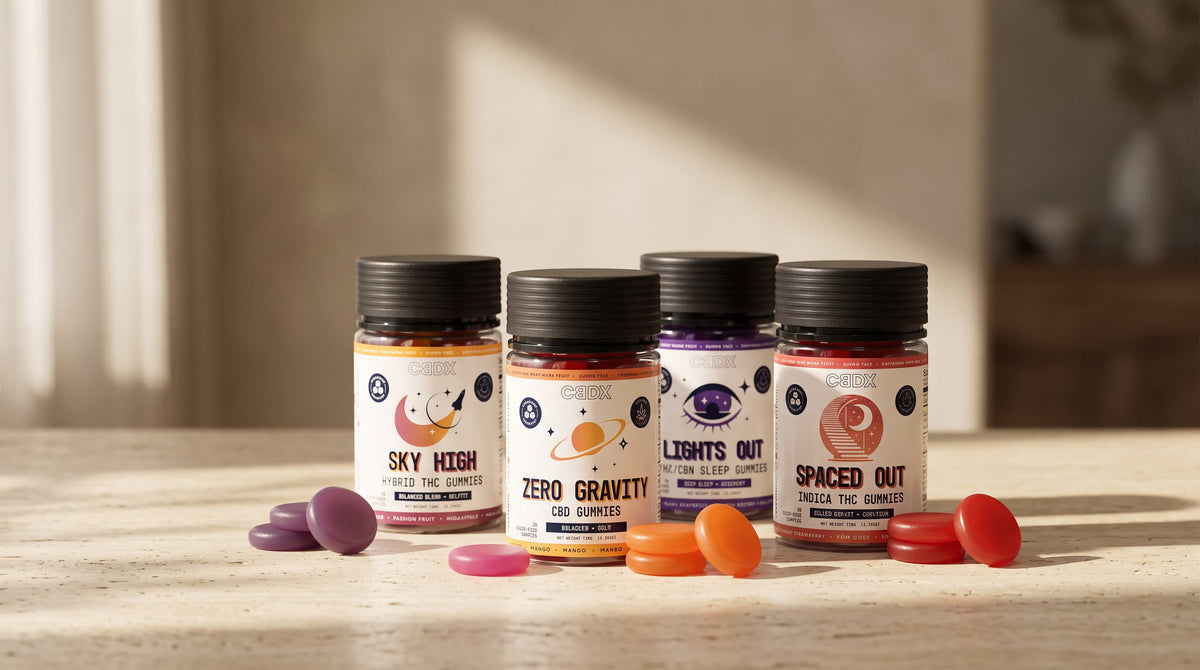
For a real-world example, Sky High Sugar-Free THC + CBD Gummies contain 5 mg THC and 5 mg CBD in the low-dose version (1:1 THC:CBD). Other strengths have different ratios, so check the selected variant.
1:1 THC:CBD — Equal Amounts
A 1:1 blend contains equal amounts of THC and CBD. It is often marketed as a balanced formula, but it can still be intoxicating, depending on the milligrams of THC per serving.
- Example: 5 mg THC + 5 mg CBD.
- Consider: Whether the THC amount fits your experience and tolerance.
2:1 CBD:THC — More CBD Than THC
With twice as much CBD as THC, CBD is the larger part of the blend. That does not mean the THC is too low to cause a high.
- Example: 10 mg CBD + 5 mg THC.
- Consider: THC sensitivity and your intended time of use.
5:1 CBD:THC — CBD-Dominant
This ratio contains five times as much CBD as THC. Some products at this ratio contain very little THC, while others still contain an intoxicating amount.
- Example: 10 mg CBD + 2 mg THC.
- Consider: The labeled THC milligrams, not just the CBD-heavy ratio.
2:1 THC:CBD — THC-Dominant
In this blend, THC is twice the amount of CBD. The same ratio can appear in lower- or higher-dose products, so check the individual milligram amounts.
- Example: 10 mg THC + 5 mg CBD.
- Consider: Greater THC exposure compared with an otherwise identical 5 mg THC serving.
For help evaluating THC milligrams, see our THC gummy dosage guide.
THC + CBN Ratios: Understanding Nighttime Blends
CBDX Spaced Out Sugar-Free Gummies combine THC and CBN. The low-dose version contains 5 mg THC and 5 mg CBN (1:1), while the mid-dose version contains 10 mg THC and 5 mg CBN (2:1 THC:CBN). Product availability may vary.
CBN (cannabinol) can form as THC degrades over time. It is often included in products marketed for nighttime use, but human evidence on CBN's sleep effects and its interaction with THC is still developing.
1:1 THC:CBN — Equal Amounts
A formula with 5 mg THC and 5 mg CBN has a 1:1 ratio. Some nighttime products use this combination, but the ratio alone cannot predict sedation or sleep quality.
2:1 CBN:THC — More CBN Than THC
A blend with 10 mg CBN and 5 mg THC has twice as much CBN as THC. It still contains 5 mg of intoxicating THC, which may be significant for a sensitive consumer.
CBDX offers Lunar Drift Sugar-Free CBN Gummies, containing 15 mg CBN and 5 mg CBD per gummy, without THC. Lunar Drift is not a premixed THC:CBN product; its individual cannabinoid amounts can be considered when comparing or planning a routine.
THC + CBG Ratios: Understanding Daytime Blends
For a THC + CBG example, Lift Off Sugar-Free Gummies contain 5 mg THC and 5 mg CBG in the low-dose version (1:1). These amounts describe the formula, not a guaranteed effect on focus or energy.
CBG (cannabigerol) is a cannabinoid produced through pathways involving CBGA, a precursor to several cannabinoids. It is often discussed in connection with daytime formulas, but evidence that CBG reliably improves focus or productivity in people remains limited.
1:1 THC:CBG — Equal Amounts
For example, 5 mg THC and 5 mg CBG. Some consumers may be interested in the combination, but there is not enough evidence to promise a predictable uplifting or clear-headed effect.
2:1 CBG:THC — More CBG Than THC
For example, 10 mg CBG and 5 mg THC. Even when CBG is the larger component, the THC amount still determines a substantial part of the intoxication risk.
Stardust Sugar-Free CBG Gummies contain 15 mg CBG and 5 mg CBD per gummy and are THC-free. Stardust is not a premixed THC:CBG product.
Why Ratios and Total THC Dose Both Matter
Consider two 1:1 THC:CBD gummies: one contains 2 mg of each cannabinoid, while another contains 10 mg of each. The ratio is identical, but the second contains five times as much THC.
Now compare a 10 mg THC + 10 mg CBD gummy with a 20 mg THC-only gummy. Both contain 20 mg total cannabinoids, but their THC amounts are different. You cannot conclude exactly how either will feel from the ratio alone.
For oral products, onset and duration also depend on digestion, food, formulation, and individual factors. Read how long THC edibles take to kick in for a fuller explanation.
Choosing a Cannabinoid Ratio: Quick Comparison
These examples explain how the numbers work. They are not prescriptions or guaranteed effects.
| Example blend | Ratio | Example serving | What to know |
|---|---|---|---|
| Equal THC and CBD | 1:1 THC:CBD | 5 mg THC + 5 mg CBD | Still potentially intoxicating |
| CBD-dominant | 5:1 CBD:THC | 10 mg CBD + 2 mg THC | Check THC mg, not only the ratio |
| CBN-dominant | 2:1 CBN:THC | 10 mg CBN + 5 mg THC | Nighttime positioning does not guarantee sleep |
| CBG-dominant | 2:1 CBG:THC | 10 mg CBG + 5 mg THC | Focus or energy effects are not guaranteed |
On mobile, swipe the table horizontally to see all columns.
Customize Your Cannabinoid Routine with CBDX
CBDX offers individual THC-free cannabinoid gummies alongside THC-containing blends. That gives you options to compare formulas and understand the total milligrams of each cannabinoid you use.
- Zero Gravity (CBD): 30 mg CBD per sugar-free gummy, without THC.
- Lunar Drift (CBN + CBD): 15 mg CBN + 5 mg CBD per sugar-free gummy, without THC.
- Stardust (CBG + CBD): 15 mg CBG + 5 mg CBD per sugar-free gummy, without THC.
You can also explore CBDX's Delta-9 THC gummy collection for formulas containing THC, CBD, CBN, and CBG. If considering more than one product, add up the total milligrams of THC and other cannabinoids across all servings. Combining products increases your total exposure, and effects are not necessarily predictable.
How to Read a Cannabinoid Product Label
- Check the order of cannabinoids. A 2:1 CBD:THC ratio is not the same as 2:1 THC:CBD.
- Read milligrams per gummy or serving. Bottle totals can make a product look stronger than an individual serving actually is.
- Look for a current Certificate of Analysis (COA). Third-party results can help verify the cannabinoid profile and identify what was tested.
- Start with a low THC dose. Health Canada advises people new to edible cannabis to consider 2.5 mg THC or less and allow up to four hours for full effects to develop.
For additional guidance, read our THC gummies for beginners article and Health Canada's lower-risk cannabis guidance.
CBDX Transparency and Formulation
At CBDX, we focus on clearly labeled cannabinoid amounts, purposeful formulations, and third-party testing. Knowing what's in each gummy makes it easier to compare products and choose an appropriate starting amount.
Hemp-derived does not automatically mean non-intoxicating or legal everywhere. Product availability and applicable rules vary by jurisdiction.
Frequently Asked Questions About THC Ratios
Does a higher CBD:THC ratio mean I won't get high?
No. A CBD-heavy ratio can still contain enough THC to cause intoxication. Always check the milligrams of THC per serving.
Can I combine gummies containing different cannabinoids?
People sometimes use more than one cannabinoid product, but combining them increases total exposure and may change effects or side effects. Check every label, avoid stacking THC doses before effects develop, and ask a healthcare professional about potential medication interactions.
Do THC:CBD, THC:CBN, or THC:CBG ratios determine how long gummies last?
Not reliably. There is not enough evidence to assign a specific onset or duration to each ratio. Edible effects often begin within 30 minutes to 2 hours, may take up to 4 hours to fully develop, and can last for several hours.
Which THC ratio is best for beginners?
There is no universally best ratio. The THC dose is a more useful starting point: a product containing 2.5 mg THC or less may be a more cautious option for someone new to edibles than a higher-dose product, regardless of its ratio.
Are hemp-derived THC ratios legal everywhere?
No. Federal hemp definitions and state restrictions are not the same thing, and laws can change. A product's cannabinoid ratio does not establish whether it can legally be sold or shipped to your location. See the USDA Hemp Program for federal hemp background.
The Bottom Line
THC, CBD, CBN, and CBG ratios are a useful way to describe how cannabinoids are combined, but they do not tell the whole story. The order of the ratio, the milligrams of each cannabinoid, and your individual sensitivity all matter.
Start by reading the label, choosing an appropriate THC amount, and giving an edible enough time to develop before taking more. The goal is to understand what you're consuming, not to chase a particular ratio.
For general education only; not medical advice. THC can impair judgment and coordination. Do not drive while impaired. Keep cannabinoid products away from children and pets. CBD and THC may interact with medications.


