



You've probably heard of CBD. It's become one of the most recognizable ingredients in the wellness world, especially for people looking to bring a little more calm and balance into their day.
But there's another cannabinoid many people have never heard of that is worth getting to know: CBG.
While CBD gets most of the attention, CBG has been generating excitement of its own, particularly for its potential effects on stress, mood, and mental clarity.
And here's where things get interesting: you don't necessarily have to choose between CBG and CBD. Because these cannabinoids have different properties, they're also being explored together in thoughtfully formulated gummies.
So what makes CBG different from CBD? What might each one offer? And why would you want both in the same gummy?
Let's get into it.
CBG vs. CBD: What's the Difference?
CBG (cannabigerol) and CBD (cannabidiol) are two naturally occurring, non-intoxicating cannabinoids found in hemp. Both interact with biological signaling systems involved in how the body responds to its environment, but they do so in different ways.
CBD is the more familiar cannabinoid, commonly associated with relaxation and everyday wellness.
CBG is gaining attention for its potential role in stress responses, mood, and cognitive function. Early human research has produced some encouraging findings, including improvements in certain measures of anxiety and stress.
Neither produces the characteristic high associated with Delta-9 THC.
The most useful way to think about them isn't that one is better than the other. It's that they're two distinct cannabinoids with different properties, and each brings something interesting to the table.
Key Takeaways
- CBD is a familiar wellness favorite. It's widely used in products designed around relaxation, calm, and balance.
- CBG is an emerging cannabinoid. Researchers are exploring its potential effects on stress, mood, and cognition.
- Both are non-intoxicating. Neither produces the characteristic THC high.
- They have different biological activity. CBG and CBD aren't interchangeable, even though they come from the same plant.
- They can be combined. Formulas containing both offer a broader cannabinoid profile, although additional benefits from combining them have not been clinically established.
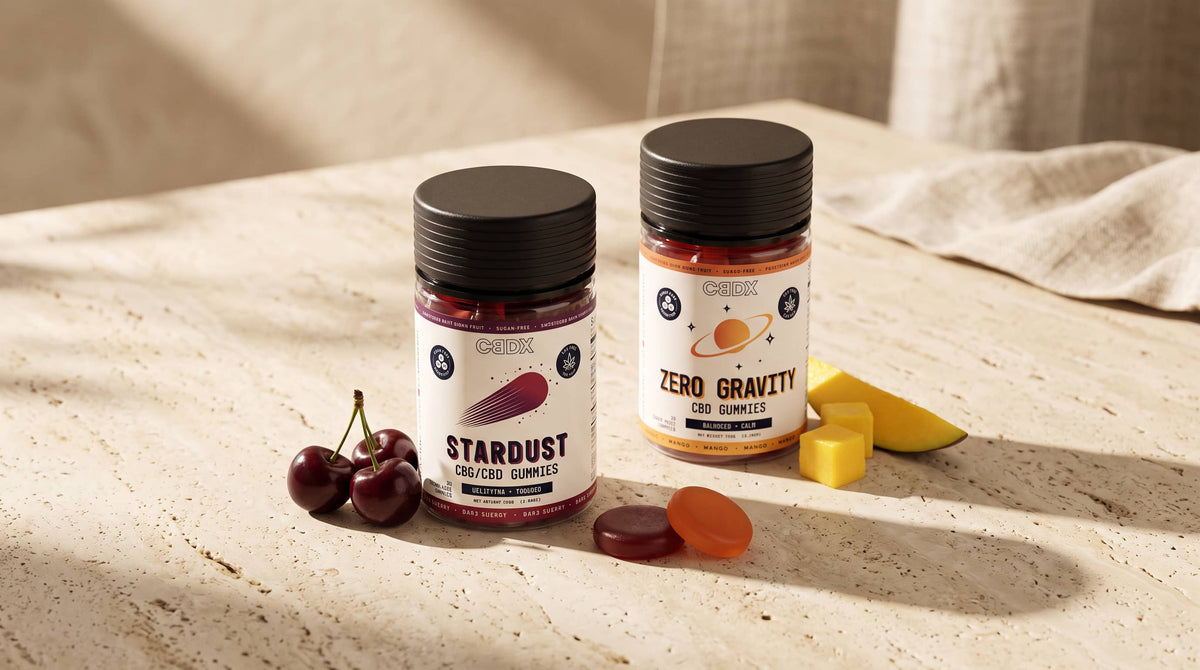
- Stardust brings them together. Each CBDX Stardust gummy contains 15 mg CBG and 5 mg CBD in a sugar-free, THC-free formula.
CBG vs. CBD: Side-by-Side Comparison
| Feature | CBD | CBG |
|---|---|---|
| Full name | Cannabidiol | Cannabigerol |
| Common wellness interest | Calm, relaxation, everyday balance | Stress, mood, mental clarity |
| THC-like high? | No | No |
| Research | Larger body of human research | Emerging human research |
| Biological activity | Acts through multiple signaling pathways | Different activity at cannabinoid receptors and other targets |
| CBDX example | Zero Gravity | Stardust, combined with CBD |
What Is CBD? The Familiar Favorite for Everyday Wellness
CBD, short for cannabidiol, is one of the most widely recognized cannabinoids found in hemp.
For many people, CBD is their introduction to the world of cannabinoids. And it's easy to understand why.
CBD is non-intoxicating, making it appealing to adults who are interested in hemp wellness without experiencing a THC high.
It's commonly included in products designed around relaxation, winding down, and finding a little more balance in everyday life.
Think of those busy afternoons, long workdays, or evenings when you're ready to leave the day's noise behind. Those are the kinds of moments that often lead people to explore CBD.
What Are the Potential Benefits of CBD?
CBD has been studied for its interactions with several biological systems, including pathways involved in stress responses and nervous system signaling.
Areas of scientific interest include:
- Stress and anxiety-related responses
- Relaxation and emotional well-being
- Sleep-related concerns
- Inflammatory and neurological signaling
Some human studies have reported encouraging findings, particularly in anxiety-related research. However, results vary across studies, and everyday CBD gummies have not been established as treatments for these conditions.
One important distinction: the FDA has approved a prescription CBD medication for certain seizure disorders. That's a specific medical use and shouldn't be confused with the effects of an over-the-counter wellness gummy.
For everyday wellness, CBD remains an appealing option for people who prefer a straightforward, non-intoxicating cannabinoid formula.
What Is CBG? Meet the Cannabinoid Getting More Attention
If CBD is the cannabinoid everyone knows, CBG is the one more people are starting to discover.
CBG stands for cannabigerol, another naturally occurring cannabinoid found in hemp.
You might have heard CBG referred to as the "mother cannabinoid." That's because CBGA, its acidic precursor, plays an important role in the plant's production of several other cannabinoids.
But CBG is interesting for more than its role in the hemp plant.
Researchers have been investigating its distinct biological activity and potential effects on stress, mood, and cognitive function.
Like CBD, CBG is generally considered non-intoxicating. That makes it an intriguing option for adults who want to explore cannabinoids without the characteristic THC high.
What Are the Potential Benefits of CBG?
CBG has attracted attention in several areas of research, particularly:
- Stress: Early human findings suggest CBG may influence some measures of stress response.
- Mood: Researchers are investigating its relationship with anxiety and emotional well-being.
- Memory and cognition: One controlled study observed improved performance on a verbal memory task.
- Everyday wellness: Its non-intoxicating profile makes CBG an interesting ingredient in daytime-oriented cannabinoid formulas.
CBG isn't a proven mood enhancer or focus treatment. But the early research gives us good reasons to be curious about its potential.
What Does the Research Say About CBG and Stress?
Here's one of the most interesting developments in CBG research.
In 2024, researchers published a randomized, double-blind, placebo-controlled crossover study involving 34 healthy adults.
Participants received 20 mg of hemp-derived CBG during one session and a placebo during another.
The researchers observed several encouraging findings with CBG compared with placebo:
- Greater reductions in self-reported anxiety
- Reduced stress at one measurement point
- Improved performance on a verbal memory task
- No detected subjective intoxication on the study's measures
That's a pretty interesting combination of findings for a cannabinoid that hasn't received nearly as much attention as CBD.
Of course, one small study doesn't tell us everything. It used a CBG tincture rather than gummies, and it doesn't establish that CBG treats anxiety or reliably improves focus.
Still, it's an encouraging starting point and one reason CBG is attracting more interest.
CBG vs. CBD for Relaxation, Mood, and Mental Clarity
So how do you actually decide between the two?
CBD has built its reputation around calm and relaxation. CBG is increasingly associated with a different set of interests, including stress, mood, and mental clarity.
Those descriptions can be helpful for understanding how the cannabinoids are positioned in wellness products, but they aren't strict scientific categories.
CBD doesn't automatically make you sleepy, and CBG isn't guaranteed to make you focused or energized.
What we do know is that the two cannabinoids have different biological properties, and that creates an interesting opportunity to formulate products with more than one cannabinoid.
Which brings us to one of our favorite questions.
Why Combine CBG and CBD? Understanding How They Complement Each Other
CBG and CBD can complement each other in a formulation because they are different cannabinoids with distinct biological activity. Combining them gives you a more varied cannabinoid profile than using either one alone.
That's the idea behind pairing them.
Rather than treating CBG and CBD as competitors, think of them as two ingredients that can play different roles within a thoughtfully designed gummy.
1. They Bring Different Properties to the Same Formula
Although CBG and CBD come from the same plant, they aren't identical.
They differ in chemical structure and in how they interact with receptors and other biological targets.
CBD has a broader history of research into stress-related responses and other areas of wellness. CBG brings its own emerging research, including the encouraging findings on anxiety, stress, and verbal memory.
Combining them allows a formula to include both cannabinoid profiles rather than relying entirely on one.
2. They Offer a Different Approach to THC-Free Wellness
One of the appealing things about CBG and CBD is that neither is known for producing the characteristic intoxicating high associated with THC.
That makes a CBG + CBD blend an interesting option for people who want to incorporate cannabinoids into their routine without seeking intoxication.
Whether it's a busy morning, a full afternoon, or a quieter evening, a non-intoxicating formulation can fit into a variety of everyday wellness routines.
Individual responses can vary, so it's still important to understand your dose and how a product affects you.
3. The Combination Is Part of the Entourage Effect Conversation
You may have heard of something called the entourage effect.
It's the idea that different compounds from the cannabis plant may influence one another's activity.
It's a fascinating area of research and one reason scientists continue exploring combinations of cannabinoids instead of studying every compound only in isolation.
That said, we can't assume that combining CBG and CBD automatically makes either one stronger. Clinical research hasn't established a consistent added benefit from this specific pairing.
What the combination does offer is a distinct formulation with two different cannabinoids, each bringing its own properties and areas of scientific interest.
And for people curious about exploring more than CBD alone, that's a compelling place to start.
Meet Stardust: Our CBG + CBD Gummies
All this talk about CBG and CBD brings us to a gummy we don't talk about nearly enough.
CBDX Stardust Sugar-Free CBG Gummies were created around a simple idea: bring two interesting, non-intoxicating cannabinoids together in one delicious, easy-to-enjoy gummy.
Each Stardust gummy contains:
- 15 mg CBG
- 5 mg CBD
- No intentionally added THC
- Sugar-free formula sweetened with monk fruit
- Rich Dark Cherry flavor
We chose a CBG-forward blend that includes CBD, giving Stardust a different cannabinoid profile from a traditional CBD-only gummy.
And while the formula is important, we also put a lot of thought into making it something you'll actually enjoy taking.
Stardust is one of our best-tasting gummies, with a rich Dark Cherry flavor that makes it an easy addition to a morning, afternoon, or evening routine.
It's designed for adults interested in a non-intoxicating wellness option, especially those curious about CBG and how it pairs with CBD.
Curious to give the combination a try? Explore CBDX Stardust CBG + CBD Gummies.
What If You Prefer CBD on Its Own?
Not everyone is looking for a combination formula, and that's perfectly fine.
If you're more interested in a CBD-focused gummy, CBDX Zero Gravity offers a different approach.
Each sugar-free Zero Gravity gummy contains 30 mg CBD, with no intentionally added THC, in a bright Mango flavor.
It's a straightforward option for people who prefer to focus on CBD rather than combining multiple cannabinoids.
That's one of the things we love about the hemp wellness space. There isn't just one way to build a routine.
CBG vs. CBD Gummies: Which Should You Choose?
Choosing between CBG and CBD doesn't have to be complicated.
Start by thinking about what interests you most.
Consider CBD If...
- You're looking for a familiar, non-intoxicating cannabinoid.
- You're interested in CBD's research and its role in wellness routines.
- You prefer a simple, CBD-focused formula.
Consider CBG + CBD If...
- You're curious about CBG's emerging research on stress and mood.
- You want to explore a cannabinoid beyond CBD alone.
- You like the idea of two different cannabinoids in one formula.
- You want a THC-free option that fits easily into your daily routine.
There's no universally better choice. Different formulations offer different cannabinoid profiles, and personal preferences matter.
Not Sure Which Gummy Is Right for You?
With so many different cannabinoids and combinations to explore, finding the right gummy can feel a little overwhelming. That's exactly why we created our Find My Gummy Quiz.
Answer a few quick questions about what you're looking for, and we'll help point you toward a CBDX gummy that fits your preferences.
Does CBG Get You High Like THC?
No. CBG is generally considered non-intoxicating and doesn't produce the characteristic high associated with Delta-9 THC.
CBD is also non-intoxicating in that sense.
However, non-intoxicating doesn't mean a substance has no effects, and a product containing CBG or CBD isn't automatically free of THC.
Always check the product label and third-party lab results, especially if avoiding THC is important to you.
Want to know more? Read our guide to whether CBG gummies get you high and what to expect.
How Much CBG and CBD Should You Take?
When you're exploring cannabinoid gummies, the amount of each cannabinoid matters.
For example, Stardust contains 15 mg CBG and 5 mg CBD per gummy. That isn't the same formula as a gummy containing 20 mg CBD, even though the total cannabinoid amount is identical.
There isn't one scientifically established dose of CBG or over-the-counter CBD that produces the same wellness effects for everyone.
Start by reading the label, following the product directions, and paying attention to how you personally respond.
CBD can cause side effects and interact with medications, and the long-term safety of CBG is less well characterized. Speak with a healthcare professional if you take medication, have an underlying condition, or have questions about whether cannabinoids are appropriate for you.
Frequently Asked Questions About CBG vs. CBD
What is the main difference between CBG and CBD?
CBG and CBD are different non-intoxicating cannabinoids with distinct chemical structures and biological activity. CBD is more widely studied and commonly associated with relaxation, while CBG is attracting interest for its potential effects on stress, mood, and cognition.
What are the benefits of CBG compared with CBD?
CBG has shown encouraging early findings involving self-reported anxiety, stress, and verbal memory in a small human study. CBD has a larger body of research, including studies involving anxiety-related responses. Neither has been proven universally better for everyday wellness.
Why combine CBG and CBD?
Combining CBG and CBD brings two cannabinoids with different properties into the same formula. It's a way to explore a broader cannabinoid profile, although studies have not established that the combination consistently works better than either cannabinoid alone.
Can you take CBG and CBD together?
Yes. CBG and CBD are included together in some commercially available gummies, including CBDX Stardust. Review the amount of each ingredient and consult a healthcare professional if you take medications or have relevant health concerns.
Is CBG better for focus than CBD?
CBG is being studied for possible cognitive effects, and one small controlled trial found an improvement on a verbal memory task. That isn't the same as proving it improves focus or productivity, but it is an interesting area of emerging research.
Does CBG make you feel relaxed?
Some people explore CBG as part of a relaxation-focused wellness routine. Early research has reported reductions in certain stress and anxiety measures, but individual experiences vary and no specific feeling is guaranteed.
Does CBG get you high?
CBG isn't known to produce the characteristic intoxicating high associated with THC. However, cannabinoid products can affect people differently, and some formulations may contain THC.
Are CBG and CBD gummies good for daytime use?
Non-intoxicating CBG and CBD formulas can be appealing for daytime routines, but individual responses vary and drowsiness or other effects are possible. Understand how a product affects you before driving or performing activities requiring alertness.
What's in CBDX Stardust gummies?
Each CBDX Stardust gummy contains 15 mg CBG and 5 mg CBD in a sugar-free, Dark Cherry-flavored formula with no intentionally added THC. It's a CBG-forward blend that includes CBD.
Will CBG or CBD show up on a drug test?
Standard workplace cannabinoid tests generally look for THC metabolites rather than CBG or CBD themselves. However, trace or unexpected THC in a product can create a risk of a positive result. No hemp product should be assumed completely drug-test safe.
The Bottom Line: CBG and CBD Are Better Understood Together Than as Competitors
CBD and CBG each have something interesting to offer.
CBD is the familiar favorite, with years of research and a well-established place in hemp wellness. CBG is the emerging cannabinoid that's opening up new conversations around stress, mood, and cognitive function.
They aren't identical, and that's exactly what makes their combination worth exploring.
By bringing two different cannabinoids into one formula, products like Stardust offer another way to discover what hemp wellness can look like beyond CBD alone.
And if you're curious about trying CBG alongside CBD, we think Stardust is a pretty delicious place to start.
Meet Stardust: 15 mg CBG + 5 mg CBD, Sugar-Free Dark Cherry Gummies.
Sources and Further Reading
- Cuttler, C., et al. (2024). Acute effects of cannabigerol on anxiety, stress, and mood: A double-blind, placebo-controlled, crossover, field trial. Scientific Reports.
- National Center for Complementary and Integrative Health: Cannabis (Marijuana) and Cannabinoids: What You Need to Know.
- U.S. Food and Drug Administration: FDA Regulation of Cannabis and Cannabis-Derived Products, Including CBD.
Disclaimer: This article is for educational purposes only and is not medical advice. CBDX products are not intended to diagnose, treat, cure, or prevent any disease. Consult a qualified healthcare professional regarding medical questions, medications, or cannabinoid use.


