



Most “focus” supplements make the same promises.
More concentration.
More productivity.
Better memory.
More energy.
And somehow, all of it without a downside.
The better question is not what a focus gummy promises.
It is:
What is actually in it, and what does the research say about those ingredients?
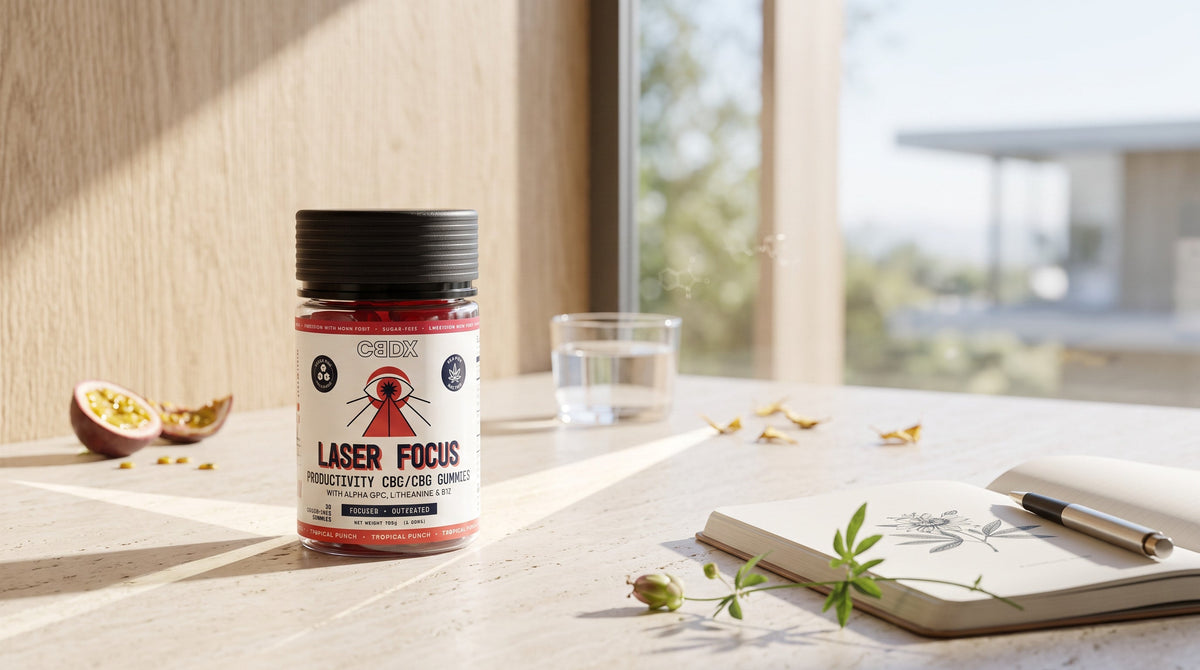
CBDX Laser Focus Gummies take an unusual approach by combining two non-intoxicating cannabinoids, 5 mg CBC + 5 mg CBG, with a broader functional ingredient blend that includes Alpha-GPC, L-Theanine, N-Acetyl L-Tyrosine, Acetyl L-Carnitine, DL-Phenylalanine, vitamin B6, and vitamin B12.
There is no caffeine and no intentional THC in the formula.
That makes Laser Focus very different from a stimulant-heavy energy gummy.
But it also does not mean every ingredient has been proven to increase focus, memory, or productivity.
Some have encouraging human evidence.
Others are much earlier in the research cycle.
Here is what is actually inside Laser Focus, why these ingredients are interesting, and what we can responsibly say about a cannabinoid-based focus gummy.
Key Takeaways
- Laser Focus Gummies contain 5 mg CBC + 5 mg CBG per gummy alongside several functional nutrients and amino acids.
- CBG has some intriguing early human research involving anxiety, stress, and verbal memory, but it has not been established as a focus or productivity treatment.
- Human research on CBC is still extremely limited, so claims that CBC improves mood or concentration are ahead of the evidence.
- L-Theanine has one of the stronger evidence profiles in the formula for attention, although effects depend heavily on dose.
- Tyrosine research suggests potential cognitive benefits particularly during demanding or stressful situations, rather than a universal boost in mental performance.
- Alpha-GPC has some emerging human research involving cognition, but the evidence in healthy adults is still limited.
- Vitamin B6 and B12 are essential nutrients, but taking extra B vitamins does not automatically improve cognition or energy in someone who is already sufficient.
- Laser Focus is not an ADHD treatment or substitute for prescribed ADHD medication.
- The finished Laser Focus formula itself has not been tested in a clinical trial, so individual ingredient research should not be mistaken for proof that the complete gummy produces a specific cognitive outcome.
What Are Focus Gummies?
“Focus gummy” is a product category, not a scientific definition.
In general, these are gummies formulated with ingredients associated with things like:
- Attention
- Mental performance
- Stress response
- Energy metabolism
- Neurotransmitter production
- Cognitive endurance
Some rely heavily on stimulants such as caffeine.
Others use vitamins, amino acids, herbal extracts, nootropics, cannabinoids, or combinations of several categories.
Laser Focus was built around a different idea:
Can you create a daytime cannabinoid gummy without THC and pair those cannabinoids with functional ingredients that have interesting cognitive research behind them?
That is the concept.
Not a pharmaceutical replacement.
Not a magic productivity gummy.
A purpose-built cannabinoid + nootropic formula.
What Is Actually in Laser Focus?
The current Laser Focus formula includes:
- 5 mg CBC
- 5 mg CBG
- Alpha-GPC
- L-Theanine
- N-Acetyl L-Tyrosine
- DL-Phenylalanine
- Acetyl L-Carnitine
- Vitamin B6
- Vitamin B12
Laser Focus is available in both a classic cane-sugar formula and a sugar-free version sweetened with monk fruit.
Let’s look at the major ingredients individually.
CBG: The Most Interesting Cannabinoid in the Formula?
CBG, or cannabigerol, is a non-intoxicating cannabinoid with some genuinely interesting early human research.
That research is still small.
But unlike many minor cannabinoids, CBG now has at least some controlled human data.
A 2024 randomized, double-blind, placebo-controlled crossover study gave 20 mg CBG to 34 healthy adults.
Compared with placebo, researchers observed:
- Lower self-reported anxiety
- Lower stress at one measurement point
- Improved performance on a verbal memory task
- No evidence of subjective intoxication
- No detected motor or cognitive impairment
That is interesting.
It is not proof that CBG makes people more productive or focused.
There are also two important limitations when applying that research to Laser Focus.
First, it was one small study.
Second, the study used 20 mg CBG, while each Laser Focus gummy contains 5 mg CBG.
So we should not simply transfer those study results onto the finished product.
Still, CBG is one of the more compelling emerging cannabinoids for researchers interested in cognition and the non-intoxicating side of cannabis.
If you want to go deeper into CBG specifically, our CBG Gummies guide breaks down the current human evidence.
CBC: Interesting, But Human Research Is Still Sparse
CBC, or cannabichromene, is another non-intoxicating cannabinoid found naturally in cannabis and hemp.
It gets far less attention than CBD, THC, CBG, or CBN.
And from a research standpoint, CBC is still very early.
Human studies have examined how CBC is absorbed and processed, but we do not currently have strong clinical evidence showing that CBC improves:
- Focus
- Memory
- Mood
- Productivity
- Attention
That does not make CBC uninteresting.
It means the research simply has not caught up with the marketing surrounding it.
Each Laser Focus gummy contains 5 mg CBC.
For now, we think the responsible way to describe CBC is as an emerging minor cannabinoid in a broader daytime formula, not as a proven cognitive enhancer.
L-Theanine: One of the Better-Studied Focus Ingredients
L-Theanine is an amino acid naturally found in tea.
It has attracted considerable research because it appears to influence attention and stress without functioning like a traditional stimulant.
This is one of the stronger ingredients in the Laser Focus concept from a human-research standpoint.
A 2026 systematic review and meta-analysis covering 31 randomized trials found that a single 200 mg dose of L-Theanine improved one measure of choice reaction time associated with attention.
The review found the acute stress effect was more modest, and anxiety findings were inconsistent.
Earlier controlled studies have also found improvements in specific attention measures at doses generally ranging from 100 to 400 mg.
That distinction matters.
Research on an individual ingredient at a specific dose does not prove that any gummy containing L-Theanine will reproduce those results.
Still, L-Theanine has a substantially better human evidence base for attention than many ingredients marketed as “brain boosters.”
N-Acetyl L-Tyrosine: The Stress-Performance Connection
Tyrosine is an amino acid the body uses to produce catecholamine neurotransmitters such as dopamine and norepinephrine.
Its cognitive research is particularly interesting under stressful or demanding conditions.
Reviews of human studies suggest tyrosine may help preserve aspects of cognitive performance when stress, sleep deprivation, cold exposure, or intense mental demands temporarily challenge normal performance.
That is a much more specific claim than:
“Tyrosine makes you smarter.”
It does not.
And the strongest evidence is generally on L-Tyrosine, while Laser Focus uses N-Acetyl L-Tyrosine, or NALT.
Those forms should not automatically be treated as interchangeable in research claims.
So the useful takeaway is:
The tyrosine pathway is interesting for maintaining performance under demanding conditions, but it is not an established general-purpose focus enhancer.
Alpha-GPC: Choline and Acetylcholine
Alpha-GPC is a choline-containing compound.
Choline is used by the body to produce acetylcholine, a neurotransmitter involved in memory, attention, learning, and other nervous-system functions.
That biological role is why Alpha-GPC appears in many nootropic formulas.
Human research in healthy adults is still fairly limited.
A small randomized crossover study published in 2024 tested 315 mg and 630 mg Alpha-GPC in 20 healthy resistance-trained men and reported improvements in some cognitive testing measures.
Interesting?
Yes.
Enough evidence to call Alpha-GPC a proven memory enhancer for everyone?
No.
The broader Alpha-GPC literature also includes clinical populations that are not directly comparable with healthy adults taking a focus supplement.
It makes sense as part of a cognitive formulation.
It should not be sold as a guaranteed mental upgrade.
Acetyl L-Carnitine: More Complicated Than “Brain Energy”
Acetyl L-Carnitine is involved in mitochondrial metabolism and is often marketed around energy and cognitive function.
It has been researched extensively in older adults and people with cognitive impairment.
The evidence for cognitive enhancement in otherwise healthy people is much weaker.
A Cochrane review concluded that there was not enough good-quality evidence to determine whether L-carnitine or its derivatives meaningfully improve cognition in healthy adults.
So we would not describe Acetyl L-Carnitine as a proven mental-performance ingredient.
Its biological role makes it reasonable to study.
The clinical claim is another question.
DL-Phenylalanine: A Neurotransmitter Precursor
Phenylalanine is an essential amino acid involved upstream in pathways that produce tyrosine and catecholamine neurotransmitters.
Laser Focus uses DL-Phenylalanine.
You will often see phenylalanine marketed around:
- Motivation
- Mental energy
- Mood
- Dopamine support
But the evidence supporting DL-Phenylalanine itself as a reliable focus enhancer in healthy adults is limited.
Again, there is a difference between:
having a plausible biochemical role
and
demonstrating a meaningful cognitive benefit in a clinical trial.
That distinction is worth keeping throughout this entire category.
What About Vitamins B6 and B12?
B vitamins are essential.
They participate in neurological function, red blood cell production, energy metabolism, and numerous other biological processes.
If someone is deficient in vitamin B12, correcting that deficiency can be extremely important.
But there is a common supplement misconception:
If a nutrient is essential for energy or cognition, taking more must create more energy or cognition.
That does not necessarily follow.
A systematic review of randomized trials involving more than 6,000 participants found no convincing evidence that B12 supplementation improved cognition in people without overt B12 deficiency.
So B6 and B12 make nutritional sense in a functional formula.
They should not be treated like stimulants.
Does Laser Focus Actually Improve Focus?
This is the question that matters.
And the most accurate answer is:
The finished Laser Focus formula has not been clinically tested as a complete product, so we cannot say that a trial has proven it improves focus or productivity.
What we can say is that it combines:
- Two non-intoxicating cannabinoids
- Several ingredients involved in neurotransmitter or neurological pathways
- Ingredients with varying levels of human cognitive research
- No intentional THC
Some ingredients, particularly L-Theanine, have meaningful human evidence around specific attention outcomes.
CBG has intriguing early human findings.
Tyrosine has research suggesting benefits under certain stressful cognitive conditions.
Others remain much less established.
That makes Laser Focus an interesting formulation.
It does not turn it into medication.
Will Laser Focus Get You High?
Laser Focus is formulated without THC and is intended to be non-intoxicating.
Its cannabinoid base is:
5 mg CBC + 5 mg CBG
Neither cannabinoid is used for the traditional intoxicating effect associated with Delta-9 THC.
CBDX currently categorizes Laser Focus among its THC-free formulas.
If completely avoiding THC is critical because of employment, drug testing, athletics, or another requirement, review the current product-specific Certificate of Analysis rather than relying solely on marketing language.
Is Laser Focus an ADHD Supplement?
No.
This is one of the biggest corrections from the old version of this article.
The previous article suggested Laser Focus might be an alternative or complementary option for people with ADHD.
There is not sufficient clinical evidence to support that claim.
Laser Focus has not been tested as an ADHD treatment.
CBG has not been established as an ADHD treatment.
CBC has not been established as an ADHD treatment.
And a multi-ingredient nootropic gummy should not be positioned as a replacement for stimulant or non-stimulant ADHD medication.
Someone with diagnosed ADHD who is considering supplements alongside medication should discuss that with their healthcare professional.
Laser Focus is better understood as:
a THC-free daytime cannabinoid and functional-ingredient gummy for adults interested in a focus-oriented formulation.
That is strong enough.
Who Is Laser Focus Designed For?
Laser Focus makes the most sense for adults who like the idea of a daytime gummy but do not necessarily want THC.
It may appeal to people looking for:
- A THC-free cannabinoid formula
- CBG + CBC in one gummy
- A non-caffeine-centered approach to daytime supplementation
- A gummy instead of capsules or powders
- A formulation that combines cannabinoids with traditional nootropic ingredients
- A sugar-free monk-fruit option or traditional cane-sugar option
The experience still varies by person.
No gummy can guarantee that you will write faster, study better, or suddenly become more creative.
When Should You Take Laser Focus?
CBDX currently recommends using Laser Focus earlier in the day rather than near bedtime.
That is product guidance rather than a scientifically established universal timing rule.
People respond differently to functional ingredients, and several components in the formula are specifically chosen for a daytime-oriented product.
If you’re trying it for the first time, take it when you can pay attention to your own response.
Follow the current serving instructions on the product label rather than increasing the amount simply because you do not notice something dramatic.
A focus gummy does not need to feel like an energy drink to be doing anything.
Cane Sugar vs. Sugar-Free Laser Focus
Laser Focus is available in two ingredient styles.
Classic Cane Sugar
Laser Focus Productivity Gummies use organic cane sugar and come in a 50-count format.
Sugar-Free
Laser Focus Sugar-Free Productivity Gummies use monk fruit instead of added cane sugar.
The cannabinoid concept remains the same:
5 mg CBC + 5 mg CBG per gummy
Choose based on your ingredient and sweetener preference rather than expecting one version to improve focus more than the other.
What Should You Look for in Any Focus Gummy?
Whether it comes from CBDX or another company, ignore the giant claims on the front for a moment.
Look at the details.
Are the Active Ingredients Clearly Listed?
You should know what you’re taking.
Are the Cannabinoid Amounts Disclosed?
“CBG blend” tells you less than:
5 mg CBG per gummy.
Is There Human Research Behind the Claims?
Ask whether the company is referencing actual human studies or simply extrapolating from test tubes and animals.
Do the Research Doses Match the Product?
This gets overlooked constantly.
If a study tested 200 mg of an ingredient and a supplement contains an undisclosed or dramatically smaller amount, the study cannot simply be pasted onto the product.
Is the Product Third-Party Tested?
CBDX works with trusted manufacturing partners to produce gummies according to our formulation, ingredient, flavor, and potency specifications.
Production batches are supported by third-party laboratory testing, with Certificates of Analysis available for transparency.
Does the Company Claim to Treat ADHD?
That should immediately make you more skeptical.
A dietary supplement should not need a medical-treatment claim to be interesting.
The Bigger Idea Behind Laser Focus
The original Laser Focus article called the product a “life hack.”
We think there’s a better way to describe it.
Laser Focus is an experiment in a part of the cannabinoid world that is still emerging:
What happens when cannabinoids aren’t designed around getting high, sleep, or relaxation at all?
CBD and THC have dominated the conversation for years.
Now cannabinoids such as CBG and CBC are creating room for entirely different types of formulations.
The science is still developing.
That’s part of what makes the category interesting.
Laser Focus brings those cannabinoids together with several established functional-supplement ingredients in one daytime gummy.
Not because every ingredient has been proven to turn you into a productivity machine.
Because there are enough interesting mechanisms and early findings to build something thoughtful without pretending the science is finished.
Frequently Asked Questions About Focus Gummies
What are focus gummies?
Focus gummies are supplements formulated with ingredients intended for daytime cognitive or mental-performance routines. Formulas vary widely and may include caffeine, amino acids, vitamins, botanical ingredients, nootropics, cannabinoids, or combinations of them.
What cannabinoids are in Laser Focus?
Each Laser Focus gummy contains 5 mg CBC + 5 mg CBG.
Does Laser Focus contain THC?
Laser Focus is currently formulated as a THC-free product using CBC and CBG rather than Delta-9 THC. Check the current product label and COA if complete THC avoidance is important to you.
Will Laser Focus get me high?
It is not designed to produce THC-like intoxication. Its cannabinoid formula uses CBG and CBC rather than THC.
Is CBG good for focus?
There is not enough human research to call CBG a proven focus supplement. One small randomized human trial found improvements in verbal memory along with reductions in anxiety and stress, but the study used 20 mg CBG and needs replication.
Is CBC good for focus?
Human research on CBC is currently too limited to say that it reliably improves focus, memory, or concentration.
Does L-Theanine improve attention?
L-Theanine has human research suggesting benefits in certain attention measures, particularly at studied doses around 100 to 400 mg. Results are not uniform across every cognitive test.
Can Laser Focus replace ADHD medication?
No. Laser Focus has not been clinically tested as an ADHD treatment and should not be positioned as a replacement for prescribed ADHD medication.
Does vitamin B12 give you energy?
Vitamin B12 is essential for normal neurological and metabolic function, particularly when someone is deficient. Supplementing additional B12 has not consistently improved fatigue or cognition in people who already have adequate B12 status.
Is Laser Focus available sugar-free?
Yes. CBDX offers a sugar-free Laser Focus formula sweetened with monk fruit, as well as a traditional cane-sugar version.
Focus Gummies: The Bottom Line
Laser Focus is not a miracle brain gummy.
And it doesn’t need to be.
It combines 5 mg CBC + 5 mg CBG with a thoughtful lineup of functional ingredients chosen around a daytime, focus-oriented concept.
Some have solid human research behind specific effects.
Some have promising early evidence.
Some are still more biologically plausible than clinically proven.
That is the honest picture.
If you want a stimulant-like jolt, this isn’t designed around that.
If you want a THC-free cannabinoid gummy built differently from the usual sleep, relaxation, or recreational products, Laser Focus occupies a genuinely interesting space.
The goal isn’t to promise superhuman focus.
It’s to build a smarter formula and let the research continue catching up.
Last reviewed and updated: September 2026


