



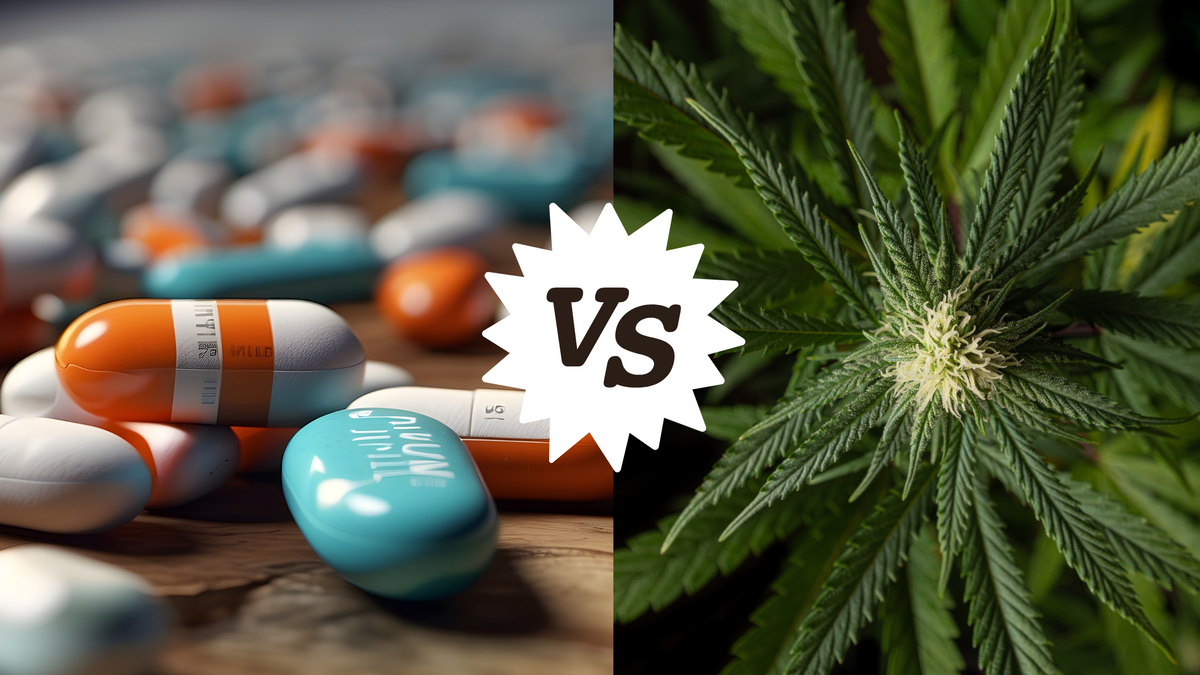
There is a big difference between falling unconscious and rebuilding a healthy relationship with sleep.
When someone has been awake night after night, that distinction can feel academic.
You want sleep.
Now.
That is exactly why Ambien became so popular.
Take a pill. Brain slows down. Sleep comes quickly.
For many people, it works.
But Ambien was approved as a short-term treatment for difficulty falling asleep, and its own prescribing information says treatment should be kept as short as possible because the risk of abuse and dependence increases with duration. It also carries the FDA's strongest boxed warning for complex sleep behaviors such as sleepwalking, sleep-driving, and doing other activities while not fully awake. Some reported events have resulted in serious injury or death.
That deserves more attention than it usually gets.
THC is not a perfect alternative.
It is intoxicating.
Tolerance can develop.
Regular use can create its own dependence and rebound-sleep problems.
But cannabinoid sleep research has improved substantially, and low-dose THC combined with cannabinoids such as CBN gives adults a very different option from a prescription hypnotic.
So the real question is not:
Which one knocks you out harder?
It is:
Which approach improves your sleep with the fewest trade-offs over time?
Quick Answer: Ambien vs THC for Sleep
Ambien and THC can both help some people sleep.
They are not equivalent.
Ambien has more standardized pharmaceutical dosing and established short-term efficacy for helping people fall asleep.
THC-containing cannabinoid products have a smaller but growing body of randomized research showing improvements in insomnia symptoms, sleep quality, sleep duration, and sleep efficiency.
Both have drawbacks.
Ambien's official labeling warns about:
-
Next-day impairment
-
Abnormal behavior
-
Complex sleep behaviors
-
Dependence
-
Withdrawal
-
Interactions with alcohol and other sedatives
THC can involve:
-
Intoxication
-
Grogginess
-
Anxiety in some people
-
Tolerance
-
Dependence with frequent use
-
Sleep disruption when regular use stops
Neither should be confused with fixing the underlying cause of chronic insomnia.
And neither belongs ahead of the fundamentals.
What Is Ambien?
Ambien is the brand name for zolpidem, a prescription sedative-hypnotic.
It acts at GABA-A receptors in the brain, increasing inhibitory signaling and reducing neuronal activity.
In practical terms:
It helps shut things down.
The FDA indication for standard Ambien is specifically the short-term treatment of insomnia characterized by difficulty initiating sleep.
Clinical studies supporting its efficacy generally lasted around four to five weeks.
That is an important piece of context.
Ambien can be very effective at what it was designed to do.
The question becomes more complicated when a short-term sleep medication quietly becomes a nightly routine lasting months or years.
The Appeal of Ambien Is Easy to Understand
Imagine you have spent three hours trying to sleep.
Again.
Your alarm goes off in five hours.
Your mind is racing.
Tomorrow matters.
Someone hands you something that reliably makes sleep arrive.
Of course that is appealing.
People taking Ambien often describe exactly that relief.
Online insomnia communities include people who say zolpidem gave them the best sleep they had experienced in years and allowed them to function again.
Some report using it long-term without dramatic problems.
Others tell a completely different story.
That contrast is important.
What People Say About Ambien Outside Clinical Trials
Clinical trials are useful.
They are not the only window into what living with a medication actually feels like.
Patient discussions around Ambien repeatedly describe experiences involving:
-
Memory gaps
-
Sleep eating
-
Conversations they cannot remember
-
Walking around while apparently awake
-
Increasing reliance on the medication
-
Fear of running out
-
Rebound insomnia when trying to stop
Recent insomnia-community posts include people describing Ambien as extremely effective while simultaneously reporting sleepwalking, sleep eating, worsening memory, or an increasing psychological dependence on knowing the pill was available.
These stories do not tell us how common those experiences are.
People with dramatic experiences are also more likely to post about them.
But dismissing all of them as anecdotes misses something important.
The FDA has independently documented the same category of complex sleep behaviors strongly enough to require a boxed warning.
So the patient stories are not describing an imaginary phenomenon.
Ambien's Most Important Warning Has Nothing to Do With REM Sleep
Older articles often make the argument:
Ambien is bad because it destroys REM sleep.
That is not the strongest argument.
Controlled studies have not consistently shown dramatic REM suppression from zolpidem.
One randomized sleep-laboratory study actually found that zolpidem increased slow-wave sleep relative to another hypnotic while improving subjective sleep quality.
So we would not build the case against routine Ambien use around the idea that it universally ruins sleep architecture.
There are more concrete concerns.
Complex Sleep Behaviors Are Real
In 2019, the FDA required a boxed warning for zolpidem and certain other Z-drugs because of rare but serious injuries involving activities performed while not fully awake.
Reported behaviors include:
-
Sleepwalking
-
Sleep-driving
-
Cooking
-
Eating
-
Taking medications
-
Wandering outside
The FDA says these events can occur even at recommended doses and can happen after the first dose or after continued use. Some have led to severe injuries and deaths.
That does not mean most people who take Ambien will start driving in their sleep.
It means the risk is serious enough that it deserves to be part of an honest comparison.
Then There Is Dependence
This is another area where the official language is surprisingly direct.
Ambien is a Schedule IV controlled substance.
Its prescribing information states that physical or psychological dependence can occur and that the risk increases with both dose and duration of treatment.
The label also acknowledges withdrawal symptoms after rapid dose reduction or abrupt discontinuation.
Reported withdrawal phenomena range from rebound insomnia and nervousness to much more serious symptoms in some circumstances.
Again, this does not mean everyone taking Ambien becomes addicted.
Dependence, addiction, and appropriate medical use are different things.
But the idea that Ambien is simply a harmless sleep switch because it came from a pharmacy does not hold up to its own prescribing information.
What About Long-Term Ambien Research?
This is where funding deserves some attention.
One frequently cited six-month randomized Ambien CR trial reported continued efficacy without obvious tolerance during the study.
That sounds reassuring.
It is also worth knowing that the study was funded by Sanofi-Aventis, the developer of zolpidem extended release.
The published disclosure lists investigators with consulting, research, advisory-board, or speaking relationships involving Sanofi and numerous other pharmaceutical companies.
That does not prove the findings are false.
Industry-funded research can still be well designed and scientifically valid.
But funding and conflicts of interest are part of the evidence.
They should not be invisible simply because the study appeared in a medical journal.
A skeptical reader should ask:
Who designed the study?
Who paid for it?
Who was selected to participate?
How long were people followed?
Which outcomes were measured?
That same skepticism should apply to cannabis research funded by cannabinoid companies too.
Bias does not only live on one side.
What About Ambien in Older Adults?
This deserves particular attention.
Z-drugs have been associated with increased falls, injuries, and fractures in older adults.
A systematic review and meta-analysis found an increased fracture risk among Z-drug users, while another review focused on older adults concluded that short-term efficacy can be good but longer-term observational evidence raises concerns about falls and fractures.
That does not establish that zolpidem caused every event.
Observational research always carries potential confounding.
But when the goal of sleep medication is to improve quality of life, an increased risk of falling at night matters.
Especially for an older person whose highest priority is remaining independent.
So Is THC Automatically Better?
No.
That would be replacing pharmaceutical marketing with cannabis marketing.
THC has its own trade-offs.
Regular use can lead to:
-
Tolerance
-
Increasing dose requirements
-
Dependence
-
Withdrawal-related insomnia
-
Vivid dreams after stopping
-
Impairment
-
Anxiety in sensitive individuals
A 2025 systematic review of cannabis and objectively measured sleep found that cannabis did not consistently alter REM sleep or other sleep stages, despite the popular claim that THC always suppresses REM.
However, withdrawal from regular cannabis use was consistently associated with poorer sleep and REM rebound.
That is important.
If you need increasing amounts of THC every night and cannot sleep without it, the fact that it came from hemp does not magically make the pattern ideal.
But the Cannabinoid Sleep Evidence Is Getting Harder to Ignore
The cannabinoid side of this comparison has changed.
A recent meta-analysis examined 10 randomized controlled trials involving 2,134 adults with insomnia or poor sleep.
Across the studies, cannabinoids were associated with:
-
Lower insomnia severity
-
Better reported sleep quality
-
Roughly 34 additional minutes of total sleep
-
Improved sleep efficiency
-
About a 12-minute reduction in sleep-onset time
Adverse effects were more common, primarily dizziness and dry mouth, and the researchers emphasized the need for larger and longer-term trials.
That is not proof that THC gummies outperform Ambien.
No good head-to-head clinical trial has answered that question.
But it does mean cannabinoid sleep support should no longer be dismissed as nothing more than anecdote.
Ambien and THC Solve the Same Problem Differently
Ambien essentially increases inhibitory signaling in the brain to facilitate sleep.
THC acts through the endocannabinoid system and can influence:
-
Arousal
-
Sensory perception
-
Stress
-
Pain perception
-
Sleepiness
Subjectively, the experiences can feel very different.
Some people describe Ambien as:
The switch flips.
With THC, people more often describe:
I finally stopped fighting sleep.
That is not a scientific endpoint.
But it may matter to the person taking it.
The Most Interesting Question Is Not Which One Is More Natural
"Natural" is not a synonym for safe.
And "prescription" is not a synonym for harmless.
Those shortcuts prevent useful thinking.
A better comparison asks:
Does it reliably improve your sleep?
How do you feel the next morning?
Are you taking more than you used to?
What happens when you skip it?
Are you experiencing memory or behavioral changes?
Is the sleep aid helping the underlying problem or simply overpowering it?
Those questions work whether the substance came from a pharmaceutical laboratory or a cannabis plant.
Ambien vs THC for Sleep
| Factor | Ambien | THC Edibles |
|---|---|---|
| Prescription required | Yes | No |
| FDA-approved for insomnia | Yes | No |
| Designed for short-term insomnia treatment | Yes | No |
| Typical onset | Relatively fast | Slower and more variable |
| Standardized dosing | Yes | Depends on product quality |
| Can cause intoxication or impairment | Yes, as a sedative | Yes |
| Complex sleep behavior boxed warning | Yes | No equivalent boxed warning |
| Next-day impairment possible | Yes | Yes |
| Tolerance possible | Yes | Yes |
| Dependence possible | Yes | Yes |
| Withdrawal can disrupt sleep | Yes | Yes |
| Human sleep research | Extensive | Smaller but growing |
| Long-term sleep data | More established, but concerns remain | Limited |
| Can combine multiple cannabinoids | No | Yes |
Neither column wins every row.
That is the point.
Before Either One: Fix the Sleep System
This may be the most important part of the entire comparison.
The strongest long-term insomnia strategy may not come in a bottle at all.
Both the American College of Physicians and the American Academy of Sleep Medicine recommend cognitive behavioral therapy for insomnia, or CBT-I, as a first-line treatment for chronic insomnia.
CBT-I is not simply:
Turn your phone off and drink tea.
It addresses the patterns that can maintain chronic insomnia, including:
-
Spending excessive time awake in bed
-
Fear and anxiety around sleep
-
Irregular sleep timing
-
Conditioned alertness at bedtime
-
Behaviors that weaken sleep drive
For someone who has spent years trying to force sleep, that can be transformational.
The Holistic Sleep Foundation Still Matters
Before escalating any sleep aid, look at the system around sleep.
Morning light
Your brain uses bright daytime light to anchor circadian timing.
A consistent wake time
Wake time is one of the strongest signals controlling the sleep-wake rhythm.
Movement
Regular physical activity helps build sleep pressure and supports overall sleep quality.
Caffeine
The coffee you barely notice at 3 p.m. may still matter at midnight.
Alcohol
Alcohol can make falling asleep easier while fragmenting sleep later in the night.
Pain
If pain keeps waking you, the sleep problem may actually be a pain problem.
Hormonal changes
Menopause and other hormonal shifts can significantly disrupt sleep.
Sleep apnea
If you snore heavily, stop breathing during sleep, wake gasping, or remain exhausted despite enough hours in bed, sedating yourself harder may be solving the wrong problem.
Restless legs
An uncomfortable urge to move the legs at night deserves its own evaluation.
The goal is not to build the world's most complicated nighttime ritual.
It is to identify what is actually keeping you awake.
Where Low-Dose THC Becomes Interesting
Once the foundation is reasonably solid, some adults still want a sleep aid.
This is where dose matters enormously.
The goal should not be:
How much THC will knock me out?
It should be:
What is the smallest amount that meaningfully improves my night?
CBDX's current Lights Out Sugar-Free Sleep Gummies offer three THC strengths, each paired with 10 mg CBN:
-
2.5 mg Delta-9 THC plus 10 mg CBN
-
5 mg Delta-9 THC plus 10 mg CBN
-
10 mg Delta-9 THC plus 10 mg CBN
The low-dose 2.5 mg version is currently identified as melatonin-free.
That 2.5 mg option is particularly relevant to this conversation.
Someone exploring THC for sleep does not necessarily need to begin with a conventional 10 mg edible.
Sometimes the more sophisticated approach is less.
Why CBN Makes the Conversation More Interesting
CBN is often marketed as the sleep cannabinoid.
The evidence is still early, but it is no longer nonexistent.
One randomized placebo-controlled study involving 293 adults found that 20 mg of CBN reduced nighttime awakenings and overall sleep disturbance.
It did not significantly shorten sleep onset.
That distinction matters.
CBN may turn out to be more interesting for sleep continuity than simply making someone unconscious faster.
Read our CBN Gummies for Sleep guide for the deeper evidence.
Lights Out combines CBN with THC rather than relying on THC alone.
That does not make it equivalent to Ambien.
It makes it a different approach.
Is Lights Out a Replacement for Ambien?
No.
And CBDX should not tell anyone to stop prescribed zolpidem and substitute a gummy.
Abruptly stopping zolpidem after regular use can produce withdrawal symptoms.
Anyone who has been taking Ambien regularly should discuss changes with the prescribing clinician rather than simply throwing the bottle away.
The more reasonable scenario is someone asking:
Do I want to begin relying on a prescription hypnotic?
or:
Are there lower-intervention options worth exploring with my healthcare professional?
That is where this comparison becomes useful.
The Problem With Chasing Unconsciousness
This may be the philosophical difference that matters most.
When sleep becomes miserable, the temptation is understandable:
Just give me something strong enough to turn me off.
But sleep is not simply unconsciousness.
Good sleep is a biological process.
The ideal long-term outcome is not finding the strongest substance capable of overpowering wakefulness.
It is restoring a sleep system that needs as little outside force as possible.
Maybe CBT-I gets you there.
Maybe fixing apnea gets you there.
Maybe reducing caffeine does more than expected.
Maybe addressing pain changes everything.
Maybe low-dose THC becomes a useful tool around the edges.
Maybe Ambien remains appropriate for a difficult short-term period.
The answer is not identical for everyone.
What If Ambien Is Working Great for You?
Then that matters.
There are people who use zolpidem appropriately, experience substantial benefit, and do not report bizarre behaviors or escalating doses.
Their experience is real too.
The existence of side effects does not mean every person taking Ambien should be frightened off of it.
But successful use still deserves periodic questions:
-
Do I still need it?
-
Is the same dose working?
-
Am I experiencing memory issues?
-
Do I feel impaired in the morning?
-
What happens when I skip it?
-
Have we ever addressed the underlying insomnia itself?
A medication working is relevant.
So is whether you still need it five years later.
What If THC Is Working Great for You?
Ask almost exactly the same questions.
-
Is the dose stable?
-
Are you sleeping better overall?
-
Do you wake refreshed?
-
Are you using more over time?
-
Can you sleep without it?
-
Are there side effects you have normalized?
-
Is THC helping the problem or becoming part of the problem?
Cannabis deserves the same skepticism as pharmaceuticals.
The goal is not loyalty to a substance.
The goal is sleep.
Frequently Asked Questions About Ambien vs THC
Is THC safer than Ambien for sleep?
There is not enough evidence to make a universal statement that THC is safer.
Ambien has specific documented risks, including an FDA boxed warning for complex sleep behaviors and recognized dependence and withdrawal concerns.
THC has a different risk profile that includes intoxication, anxiety, tolerance, dependence, and withdrawal-related sleep disruption.
Is Ambien intended for long-term use?
Standard Ambien labeling describes it as a short-term treatment and says treatment should be as short as possible because dependence risk increases with duration.
Does Ambien ruin REM sleep?
The evidence does not support saying zolpidem universally destroys REM sleep.
Sleep-architecture studies have produced more nuanced findings.
Does THC ruin REM sleep?
Not consistently.
A 2025 systematic review found mixed effects on REM and other stages, particularly at lower therapeutic doses, while withdrawal after regular cannabis use more consistently disturbed sleep and produced REM rebound.
Can THC become habit-forming for sleep?
Yes.
Tolerance and dependence can develop with regular cannabis use, and stopping frequent use can temporarily worsen sleep.
Can Ambien become habit-forming?
Yes.
Its official labeling recognizes physical and psychological dependence, with risk increasing as dose and duration increase.
Can I take THC and Ambien together?
Do not casually combine them.
Both can impair the central nervous system, and combining sedating or intoxicating substances can increase impairment.
Discuss the combination with the healthcare professional managing your medications.
What is the lowest-dose CBDX sleep gummy?
Current Lights Out low-dose gummies contain 2.5 mg Delta-9 THC plus 10 mg CBN.
For a deeper look at THC dosing, see the CBDX THC Gummy Dosage Guide.
The Bottom Line: Sleep Should Need Less Force Over Time, Not More
Ambien works.
That is why people use it.
THC works for some people too.
That is why millions of adults have incorporated cannabis into nighttime routines.
The interesting part starts after that.
What is the cost of the sleep you are getting?
If a medication helps you sleep but your dose keeps rising, that matters.
If you cannot remember what happened after you took it, that matters.
If THC helps but eventually you cannot sleep without cannabis, that matters too.
If something lets you sleep beautifully, wake refreshed, remain functional, and maintain a stable low dose, that matters.
The smartest long-term sleep strategy is probably not ideological.
It is not:
Pharmaceutical bad.
It is not:
Natural good.
It is:
Use the least force necessary to restore the most natural sleep you can.
Start with the system.
Light.
Movement.
Circadian rhythm.
Stress.
Pain.
Caffeine.
Sleep apnea.
CBT-I.
Then decide what additional support actually earns its place.
For someone who chooses cannabinoids, low-dose THC with CBN represents a very different path from taking a prescription hypnotic.
CBDX Lights Out Sleep Gummies currently begin at 2.5 mg Delta-9 THC plus 10 mg CBN.
For the deeper science, read our THC for Sleep and Insomnia guide and our CBN Gummies for Sleep guide.
Neither Ambien nor a gummy should become the hero of the story.
Sleep should.
This article is for general educational purposes only and is not medical advice. Do not abruptly stop or change prescribed zolpidem or another sleep medication without consulting the healthcare professional managing it. THC is intoxicating and may impair judgment, coordination, and driving ability. Do not combine intoxicating or sedating substances without appropriate medical guidance.
Last reviewed and updated: September 2026


