



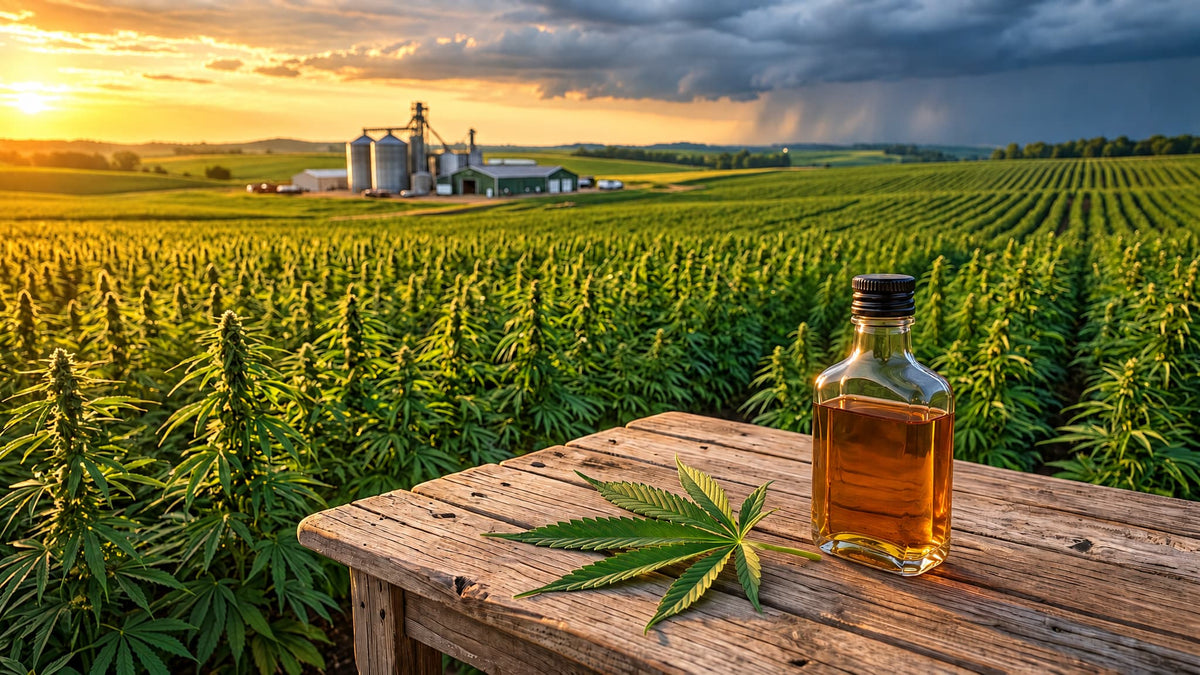
New federal restrictions threaten a multibillion-dollar American industry. But while hemp businesses face closure, some established industries may benefit, including alcohol companies that helped push for the crackdown.
Imagine building a successful business under federal law, investing years of work and millions of dollars, only to have Congress change the rules and potentially wipe out your market.
That's the situation facing thousands of American hemp businesses.
Beginning in late 2026, new federal restrictions will remove the legal hemp classification from many THC gummies, beverages, and even certain full-spectrum CBD products.
The potential fallout is enormous. A September 2026 economic analysis estimates that up to $28.3 billion in annual retail sales and approximately 225,000 jobs could be at risk.
But the most interesting part of this story isn't just who stands to lose.
It's who stands to gain.
Several major alcohol industry associations supported removing intoxicating hemp products from the market, just as THC beverages were emerging as an increasingly popular alternative to drinking.
Coincidence? Legitimate regulatory concerns? Economic self-interest?
The evidence makes this worth examining.
Key Takeaways
- Billions are at stake. The restrictions could disrupt $28.3 billion in annual hemp sales and put approximately 225,000 jobs at risk.
- The impact extends far beyond hemp brands. Farmers, manufacturers, laboratories, packaging suppliers, distributors, and online retailers could all be affected.
- Major alcohol trade groups supported the crackdown. Their involvement coincided with declining alcohol consumption and growing interest in THC beverages.
- Some consumers are replacing alcohol with THC drinks. Research suggests meaningful substitution among certain consumers.
- The restrictions do not directly close marijuana dispensaries. Businesses relying on the federal hemp classification face the greatest disruption.
What Is Changing?
The 2018 Farm Bill legalized qualifying hemp at the federal level, creating the foundation for a thriving industry selling CBD and hemp-derived THC products.
Businesses invested in farming, manufacturing, product development, and nationwide distribution based on that framework.
Congress has now significantly narrowed the definition of legal hemp.
Under legislation enacted in November 2025, finished cannabinoid products exceeding 0.4 milligrams of total THC and certain similar cannabinoids per container will no longer qualify for the federal hemp exemption.
That's the entire package, not an individual gummy or serving.
Most existing THC gummies and beverages will exceed that threshold. Even some full-spectrum CBD products containing naturally occurring THC could be affected.
Following a September 2026 extension, certain synthetic-cannabinoid restrictions are scheduled for November 12, with most of the revised hemp definition taking effect December 11, 2026.
Importantly, this does not directly shut down state-licensed marijuana dispensaries. The biggest impact falls on hemp businesses that built their operations around federally permitted products, mainstream retail, and interstate commerce.
The $28 Billion Domino Effect
The financial consequences could extend well beyond the companies selling gummies and beverages.
According to Whitney Economics' September 2026 report:
| Potential economic impact | Estimate |
|---|---|
| Annual retail sales at risk | $28.3 billion |
| Jobs potentially displaced | 225,000 |
| Employee wages at risk | $8.9 billion |
| State sales tax potential at risk | $2.1 billion |
| Broader modeled economic losses | $86.6 billion |
Even more striking, 68.1% of surveyed hemp businesses expected to close entirely under the new restrictions.
These are projections, not guaranteed losses. But they illustrate the industry's exposure.
Consider what happens when a hemp company stops selling its products.
Manufacturers lose orders. Farmers lose buyers. Laboratories lose testing revenue. Packaging companies, fulfillment centers, freight carriers, and countless other service providers lose customers.
The effects spread to workers, local businesses, commercial landlords, and state tax revenue.
And the uncertainty is already discouraging companies from expanding or investing in new products.
The economic damage doesn't have to wait until the law takes effect.
Meanwhile, Americans Are Drinking Less
While hemp businesses were growing, the alcohol industry faced a very different trend.
In August 2026, Gallup reported that just 54% of American adults drink alcohol, down from 62% in 2023 and matching the lowest level recorded since 1939.
Health concerns, changing lifestyles, and shifting consumer preferences have all contributed.
And an interesting alternative has been gaining ground: THC beverages.
For some consumers, THC seltzers offer a familiar social experience without alcohol.
By 2025, the hemp-derived THC beverage market was projected to exceed $1 billion in annual U.S. sales.
Still small compared with beer, wine, and spirits, but growing quickly enough to attract the attention of major beverage companies.
Reuters reported that alcohol producers were watching the emerging category as their traditional sales weakened.
And there is evidence that THC beverages weren't simply another purchase.
For some people, they were replacing alcohol.
A 2026 study published in the Journal of Psychoactive Drugs found that cannabis-beverage consumers reported drinking approximately seven alcoholic beverages per week before adopting THC drinks, compared with 3.4 afterward.
The study relied on self-reported observations and cannot establish causation, but the pattern is noteworthy.
Another survey, conducted by THC beverage company Crescent Canna, found that 76.6% of respondents reported reducing or eliminating alcohol after trying THC drinks. Nearly one-quarter said they would drink more alcohol if THC beverages became unavailable.
That company-sponsored survey has limitations, but the findings raise an important question:
If THC beverages disappear, how much of that spending returns to alcohol?
Did the Alcohol Industry Help Push the Ban?
Here's where the story takes a revealing turn.
In November 2025, five major alcohol trade associations jointly urged Congress to remove intoxicating hemp products from the marketplace until comprehensive federal regulations could be established.
They included the Beer Institute, the Distilled Spirits Council of the United States, the American Distilled Spirits Alliance, WineAmerica, and the Wine Institute.
The groups argued that inconsistent regulation created safety concerns and unfair differences in how intoxicating products were treated.
Those concerns aren't without merit.
But the competitive implications are difficult to ignore.
The Beer Institute has also supported policies that would restrict intoxicating hemp products to dispensaries if legalized, prohibit their sale alongside alcoholic beverages, and impose particularly high excise taxes.
These are documented positions, not speculation. Marijuana Moment covered the coalition's congressional effort.
Does this prove alcohol companies wanted to eliminate competition? No.
But when an established industry supports restricting a growing alternative to its own products, financial incentives deserve scrutiny.
Interestingly, not everyone in the alcohol business agrees.
Wine and Spirits Wholesalers of America has supported regulating rather than banning hemp-derived THC beverages. Distributors and retailers that profit from selling THC drinks have a different perspective from producers who may view them as competition.
That division says a great deal about what's really at stake.
Who Benefits When Hemp Businesses Lose?
The potential winners aren't limited to alcohol companies.
Alcohol producers could recover some customers who were using THC beverages instead of beer, wine, or spirits.
State-licensed marijuana dispensaries may gain customers who previously purchased hemp products online or through conventional retailers, although availability and laws vary dramatically by state.
Unregulated sellers could also benefit if consumers continue seeking products that are no longer available through established businesses.
That last possibility deserves particular attention.
Removing legal supply doesn't necessarily eliminate demand. It can redirect consumers toward markets with weaker testing, labeling, and accountability.
And that brings us to the central question behind the restrictions.
Why Not Regulate Instead of Ban?
The hemp industry has had legitimate problems, including inconsistent product testing, inaccurate labeling, questionable manufacturing practices, and inadequate age restrictions.
Those issues need to be addressed.
But regulation and prohibition are very different approaches.
Clear national standards for age verification, independent laboratory testing, potency labeling, packaging, and manufacturing could address many concerns while preserving legitimate businesses and consumer access.
Instead, the new restrictions threaten to eliminate much of the existing market, including some full-spectrum CBD products that aren't intended to produce intoxication.
Whether that approach improves public safety remains to be seen.
What is already clear is that the economic consequences could be substantial.
The Bigger Picture
The 2026 hemp ban is more than a cannabis policy story.
It's about what happens when an emerging American industry, built under rules established by Congress, suddenly faces the loss of its legal foundation.
Farmers, entrepreneurs, manufacturers, employees, and countless supporting businesses could pay the price.
Meanwhile, established competitors may benefit from the disappearance of products that were beginning to challenge their market share.
The alcohol industry's involvement is particularly significant because it comes at a time when Americans are drinking less and THC beverages are offering consumers another choice.
Nobody knows exactly how much money will change hands, how many businesses will survive, or where consumers will turn.
But one thing is certain: restricting an industry doesn't necessarily eliminate the demand it serves.
It changes who gets the opportunity to serve it.
And with billions of dollars at stake, that's a question worth asking.
Frequently Asked Questions
When does the 2026 hemp ban take effect?
Certain synthetic-cannabinoid restrictions begin November 12, 2026. Most of the revised federal hemp definition, including the 0.4-milligram-per-container limit, takes effect December 11, 2026, under current law.
Will CBD also be banned?
Not all CBD products. However, some full-spectrum CBD products containing naturally occurring THC could exceed the new limit.
Does the ban affect marijuana dispensaries?
The law does not directly shut down state-licensed marijuana dispensaries, which operate under separate state cannabis programs.
How much could the ban cost the economy?
Whitney Economics estimates up to $28.3 billion in retail sales and approximately 225,000 jobs could be at risk. These are projections, not confirmed losses.
Did alcohol companies lobby for the hemp restrictions?
Yes. Several major alcohol producer associations supported removing intoxicating hemp products from the market pending federal regulation. Other alcohol-industry groups supported regulating rather than banning them.
Will Americans drink more alcohol if THC beverages disappear?
Some might. Surveys suggest certain consumers have substituted THC beverages for alcohol, but the broader effect on national drinking habits remains uncertain.


