



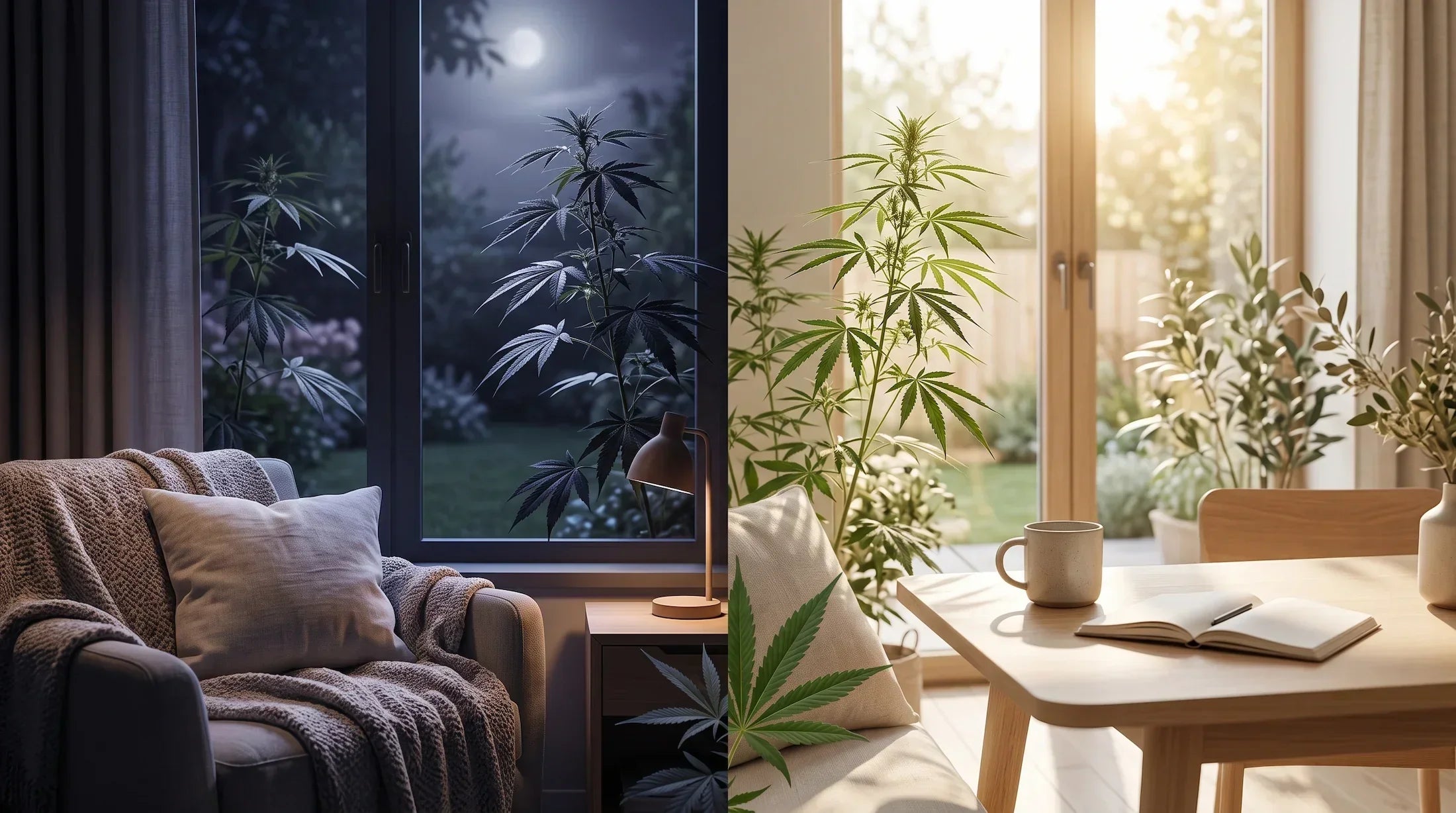
If you're choosing cannabis for nighttime, you've probably heard the same advice: Indica makes you sleepy. Sativa gives you energy.
That's a useful starting point, but the real answer is more complicated.
Indica products are traditionally associated with calmer, more relaxing effects, while Sativa products are generally associated with a more uplifting or energizing experience. But the words Indica and Sativa alone can't reliably predict exactly how a cannabis product will make you feel.
The cannabinoid profile, terpene profile, THC dose, method of consumption, and your own individual response can all influence whether cannabis leaves you ready for bed or wide awake.
So, does Indica or Sativa make you sleepy? Indica is generally the better place to start when relaxation and sleep are the goal, but there's much more worth looking at than the name on the label.
Indica vs. Sativa: What's the Difference?
Indica and Sativa have long been used as shorthand for two different types of cannabis experiences.
Traditionally, the distinction looks something like this:
- Indica: Relaxing, calming, body-focused and commonly associated with nighttime
- Sativa: Uplifting, energizing, mentally stimulating and commonly associated with daytime
- Hybrid: A combination that may lean toward either side
There's a catch.
Modern research suggests that the Indica/Sativa labels used on commercial cannabis products aren't particularly reliable indicators of a plant's overall genetic or chemical makeup. One analysis of more than 100 cannabis samples found that products labeled Indica and Sativa were genetically indistinct on a genome-wide scale, although certain terpene patterns were associated with the labels.
In other words, Indica and Sativa can be useful clues, but they don't tell you the whole story.
So, Does Indica or Sativa Make You Sleepy?
If you're choosing between the two specifically for nighttime, Indica is traditionally the sleepier choice.
Many people associate Indica products with a heavier, more body-centered sense of relaxation that feels better suited to unwinding at the end of the day. Sativa products, on the other hand, are generally associated with a brighter, more uplifting experience.
But two products labeled “Indica” can still feel very different.
That's because the experience isn't coming from the word Indica. It's coming from the actual chemical profile and dose of the product, combined with how your body responds to it.
For sleep, it's worth looking beyond the strain label at a few other factors.
THC, CBD, and Sleep
Two of the best-known cannabinoids in cannabis are THC (tetrahydrocannabinol) and CBD (cannabidiol).
THC is responsible for the intoxicating effects associated with cannabis. Depending on the person and dose, THC can feel relaxing and may make it easier to wind down. But more isn't necessarily better. Higher doses can produce unwanted effects such as anxiety or an experience that's simply too intense to be relaxing.
CBD isn't intoxicating and produces a very different experience. It's commonly used as part of nighttime wellness routines, but the research surrounding CBD, THC, and sleep is still evolving.
A 2024 review of cannabinoid-based therapies for sleep disorders found growing research interest but concluded that the evidence still doesn't match how widely cannabinoids are currently used for sleep.
That's an important distinction: cannabis may help some people relax at night, but it shouldn't be treated as a guaranteed sleep solution.
Don't Forget About CBN
THC and CBD get most of the attention, but they're not the only cannabinoids worth knowing about when you're thinking about nighttime.
CBN (cannabinol) is another naturally occurring cannabinoid that's become increasingly popular in products formulated specifically for evening use.
Unlike THC, CBN isn't generally sought out for a strong intoxicating effect. Instead, you'll often see it paired with other cannabinoids in formulas designed around relaxation and nighttime routines.
This is also a good example of why looking at the entire formula can tell you more than simply looking for “Indica” on the package.
What About Terpenes?
Cannabinoids aren't the only compounds that make one cannabis variety different from another.
Terpenes are aromatic compounds found throughout the plant world, including cannabis. They're responsible for much of the distinctive aroma and flavor associated with different cannabis varieties.
You may have heard certain terpenes described as “sleepy” or “energizing.”
For example:
- Myrcene is commonly associated with earthy aromas and relaxation.
- Linalool, also found in lavender, is frequently associated with a calming profile.
- Limonene has a bright citrus aroma and is commonly associated with more uplifting varieties.
But we should be careful about treating these descriptions as guarantees.
Researchers continue to investigate whether and how terpenes meaningfully modify the effects of cannabinoids. A recent systematic review found interesting preliminary evidence around individual terpenes but concluded that claims of predictable cannabinoid-terpene synergy remain unproven.
So rather than thinking “this terpene will make me sleepy,” think of the terpene profile as another piece of information that may help you understand a product's overall character.
Why the Same Cannabis Can Affect Two People Differently
Here's where things get personal.
Two people can take the same amount of the same product and have noticeably different experiences.
Your response can be influenced by factors including:
- Cannabis tolerance
- Previous experience with THC
- Dose
- Individual sensitivity
- Other substances or medications
- The specific cannabinoid and terpene profile
That's why finding what works for you usually involves some experimentation.
If you're new to THC, starting with a low dose and giving yourself enough time to understand how it affects you is generally a much better strategy than assuming a stronger dose will produce better sleep.
Edibles vs. Smoking: Does It Matter for Sleep?
Absolutely.
How cannabis is consumed can significantly change the timing and duration of the experience.
Inhaled cannabis generally takes effect relatively quickly and wears off sooner.
Edibles take longer to kick in because THC is processed through the digestive system and liver before reaching the bloodstream. Their effects can also last considerably longer.
That longer duration is one reason some people prefer edibles as part of an evening routine. It's also why dosing matters so much.
Taking another edible because you “don't feel it yet” can easily turn a relaxing night into a much stronger experience than you intended.
Start low, give it time, and don't rush the dose.
What Should You Look for When Choosing Cannabis for Sleep?
Rather than simply asking “Indica or Sativa?”, ask a few better questions:
- Is the product intended for daytime or nighttime use?
- How much THC does one serving contain?
- What other cannabinoids are included?
- Does the formula contain CBN or CBD?
- What is the terpene profile, if provided?
- How have you personally responded to similar products before?
For someone looking primarily to unwind at night, an Indica or Indica-leaning product can still be a logical starting point. Just don't treat the word Indica as a guarantee.
The actual formula matters.
If you're exploring gummies specifically formulated for nighttime, you can also browse our sleep gummies, including THC, CBN, and THC-free options.
Indica vs. Sativa for Sleep: The Bottom Line
So, does Indica or Sativa make you sleepy?
Indica is more commonly associated with relaxation and sleepiness, while Sativa is traditionally associated with energy and uplift. But those labels alone don't determine how a cannabis product will affect you.
THC dose, other cannabinoids, terpenes, product formulation, consumption method, tolerance, and your individual response can all matter.
If nighttime relaxation is your goal, use Indica as a starting point rather than the entire decision.
Look at what's actually inside the product, start with a dose you're comfortable with, and pay attention to what works for you.
Frequently Asked Questions
Is Indica or Sativa better for sleep?
Indica is traditionally associated with relaxation and nighttime use, making it the more common choice for sleep. However, the Indica/Sativa label alone isn't a reliable predictor of effects. Cannabinoids, terpenes, dose, and individual response also matter.
Does Indica always make you tired?
No. Although Indica products are commonly associated with relaxation, not every Indica will make every person sleepy. Individual responses to cannabis can vary considerably.
Can Sativa make you sleepy?
It can. Sativa is traditionally associated with more uplifting and energizing effects, but cannabis affects everyone differently. The chemical profile, THC dose, and individual response may matter more than the Sativa label itself.
Is THC or CBD better for sleep?
They work differently, and neither should be considered a guaranteed sleep aid. THC is intoxicating and can feel relaxing to some people, while CBD is non-intoxicating. Research into cannabinoids and sleep is ongoing, and current evidence isn't strong enough to make broad claims that either consistently improves sleep.
What cannabinoid is commonly used in nighttime gummies?
In addition to THC and CBD, CBN is increasingly found in cannabinoid products formulated for nighttime use. Products may combine cannabinoids rather than relying on one ingredient alone.
Do terpenes determine whether cannabis makes you sleepy?
Not by themselves. Terpenes such as myrcene and linalool are commonly associated with relaxing profiles, but current research doesn't support treating individual terpenes as reliable predictors of whether a cannabis product will make someone sleepy.


